



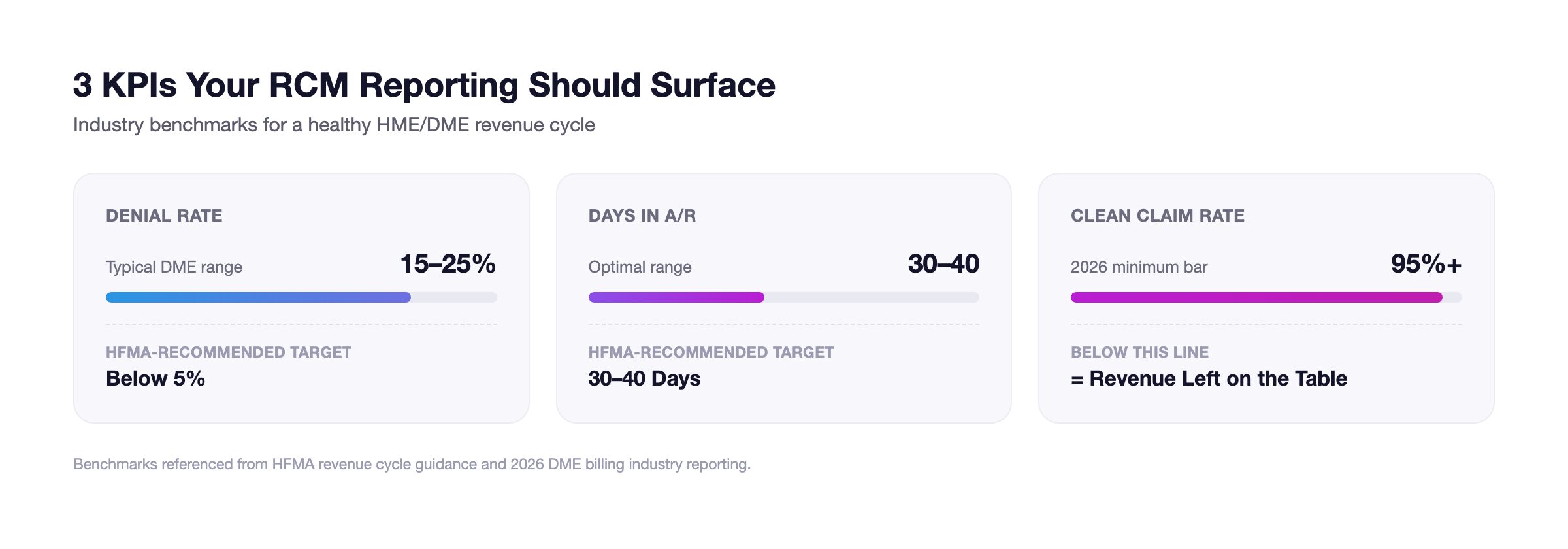
HME revenue cycle management is where most DME/HME suppliers quietly lose money — not to bad debt, but to denials, rework, and claims that sit in accounts receivable for months. Industry data puts the average DME claim denial rate between 15% and 25%, and a conservative 60–70% of those denials trace back to workflow gaps that the right system would have caught before the claim ever left the building. On paper, that looks like a billing problem. In practice, it’s an RCM problem — the software and processes behind billing either catch those gaps early or let them compound quietly for months.
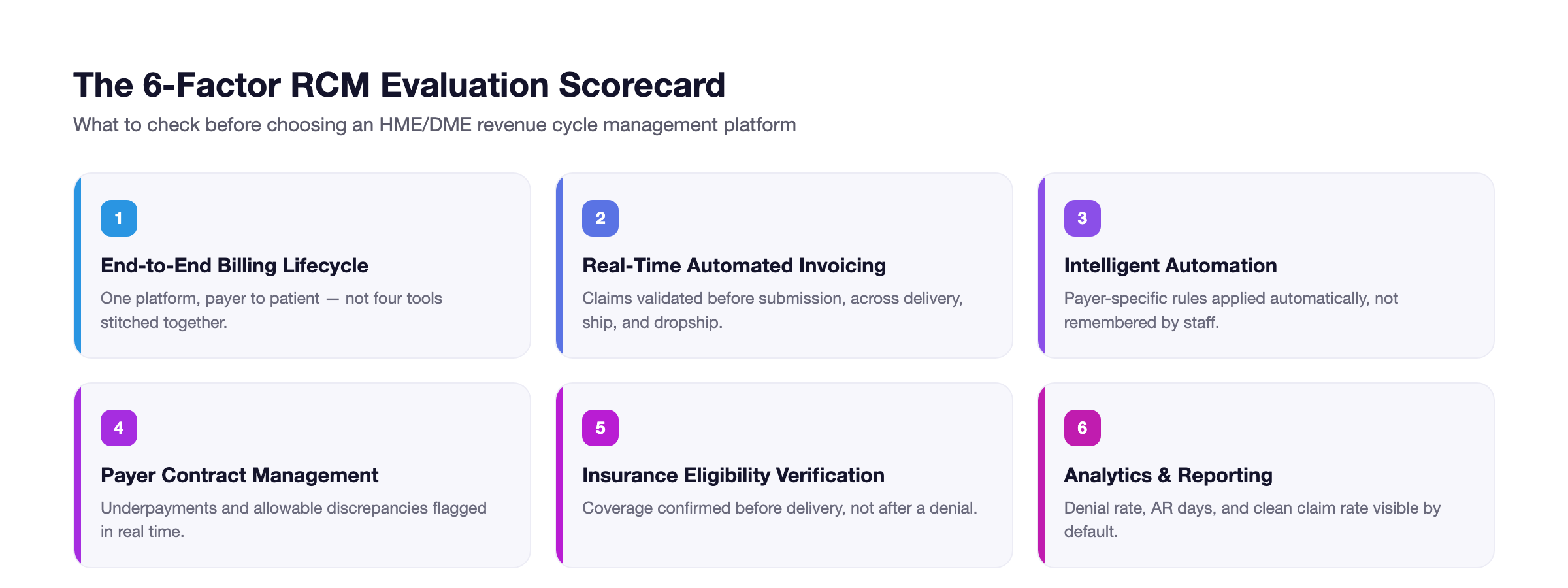
Choosing the right revenue cycle management (RCM) solution is the single decision most likely to fix that, because it touches every stage a claim passes through, not just the moment it’s submitted. But “RCM software” has become a broad enough category that two platforms can both claim the label while covering completely different ground — one might automate invoicing and stop there, while another handles eligibility, contracts, and reporting too. These six factors separate platforms that actually move the needle on cash flow from ones that just add another login to your day.
What HME Revenue Cycle Management Actually Covers
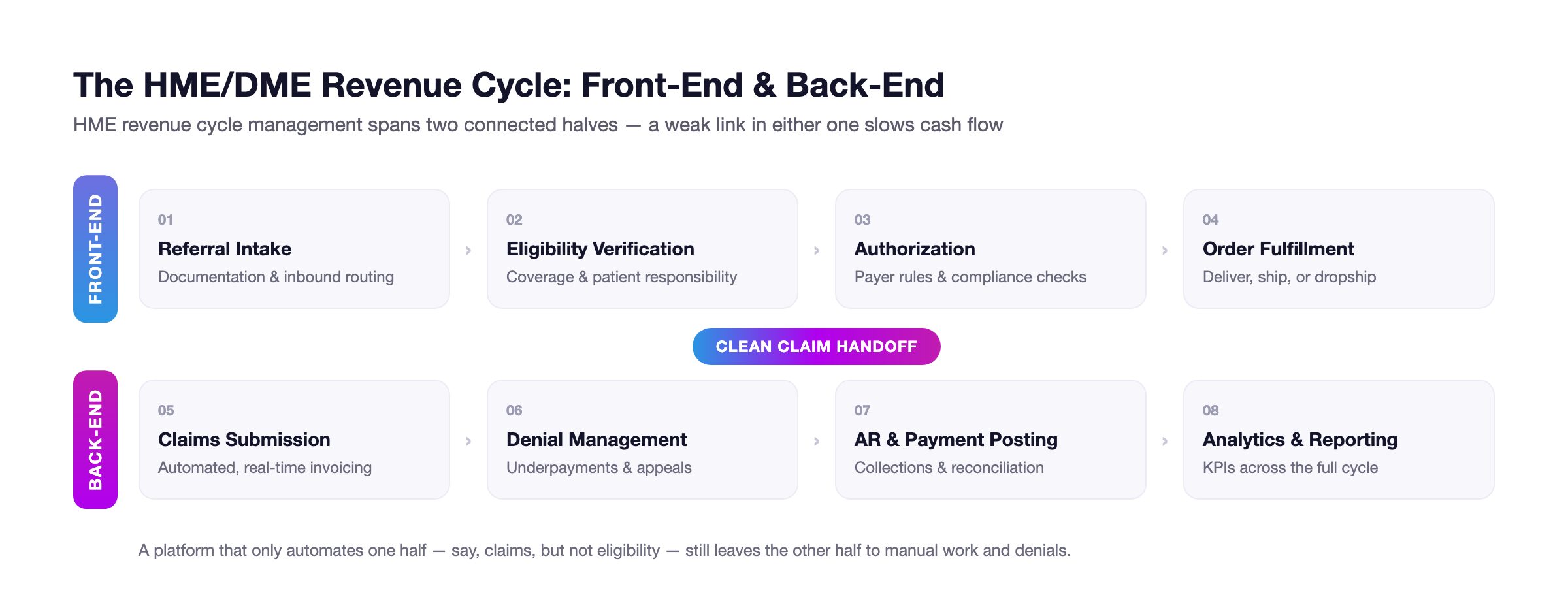
Revenue cycle management for HME/DME isn’t one process — it’s two, chained together. Front-end RCM covers everything before a claim exists: referral intake, documentation, eligibility verification, authorization, and order fulfillment. Back-end RCM picks up from there: claims submission, denial management, accounts receivable, payment posting, and reporting. A weak link in either half produces the same symptom — slow cash flow — which is why a real RCM evaluation has to span both sides of the cycle instead of treating billing as a single, isolated step.
This distinction matters more than it sounds. A supplier can have flawless back-end claims automation and still bleed revenue if front-end eligibility checks are inconsistent, because a claim built on bad eligibility data is denied no matter how well it’s submitted. The six factors below map to both halves of the cycle on purpose — three touch front-end accuracy, three touch back-end recovery and visibility.
1. End-to-End Billing Lifecycle Management: Simplifying Complexity
A capable RCM platform manages the entire DME billing lifecycle (payer to patient) on one platform, rather than stitching together separate tools for intake, billing, and collections. That matters practically: new hires ramp up faster on one system than on four, and nothing falls into the gap between disconnected tools where a referral gets logged in one place but never makes it into the billing queue. If your team spends time re-entering the same patient or order data in a second system, that’s revenue cycle management working against you, not for you — every manual re-entry is another point where a typo or a missed field turns into a denial three weeks later.
2. Real-Time Automated Invoicing: Accelerating Cash Flow
Cash flow depends on how fast a clean claim goes out the door. Real-time automated invoicing should work the same way regardless of fulfillment method (whether you deliver, ship, or dropship through a third-party vendor), managing claims, payments, denials, and authorizations so every claim is validated before submission, not after a denial comes back. Current industry guidance puts the clean-claim-rate bar at 95% or higher; anything below that is revenue sitting in a resubmission queue instead of your bank account. The practical test: ask how a prospective platform handles a dropship order from a third-party vendor specifically, since that’s the fulfillment path most legacy billing tools were never built to automate.
3. Intelligent Automation: Customizing and Streamlining Workflows
Rules management lets you encode payer-specific requirements (compliance rules, frequency limits, documentation triggers) once, instead of relying on staff to remember them claim by claim. This is also where AI is changing the math fastest: DME providers running AI-integrated claims workflows are reporting meaningfully shorter days-sales-outstanding by catching documentation gaps automatically, ahead of CMS’s own increasing reliance on automated oversight in 2026. The goal isn’t automation for its own sake — it’s fewer manual touches per claim, and denials caught before submission instead of after. Ask a vendor to walk through one payer’s actual frequency or documentation rule inside their system; if it takes a support ticket to configure, it isn’t really automation.
4. Payer Contract Management: Identifying Discrepancies in Real Time
Fee schedules change, and payers don’t always reimburse at the contracted rate. A platform with real configuration depth flags underpayments and allowable discrepancies as they happen, not during a quarterly audit three months later. That real-time visibility is what turns payer contract management from a compliance checkbox into recovered revenue you’d otherwise write off without ever noticing it was missing. Multiply a small per-claim underpayment across hundreds of claims a month and the gap between “we’ll audit that eventually” and “we caught that today” is real money, not a rounding error.
5. Insurance Eligibility Verification: Improved Patient Financial Experience
Eligibility verification against commercial and government payers should happen before delivery, not after a denial. Confirming coverage, patient responsibility, and coverage guidelines upfront lets you give patients a real, personalized estimate and collect at the point of service, which prevents both denials and the write-offs that come from billing a patient weeks later for an amount they weren’t expecting. It also changes the patient relationship: a clear estimate before delivery reads as professionalism, while a surprise bill a month later reads as a billing error, even when the underlying charge was always correct.
6. Analytics and Reporting Tools for Business Control
Billing is only half the picture; the other half is knowing where you stand. Denial rate by payer, days in accounts receivable, and clean claim rate are the KPIs that tell you whether your revenue cycle is actually healthy — HFMA’s own benchmarks put optimal days in A/R at 30–40 days and denial rates under 5%, well below the 15–25% many DME suppliers run today. A solution that surfaces these numbers by default, instead of requiring a manual export and a pivot table, is the difference between managing your revenue cycle and reacting to it every quarter. If your current reporting can’t tell you which payer is driving most of your denials without a manual pull, that’s a gap worth fixing before it’s worth automating anything else.
Signs Your Current RCM Setup Is Costing You Money
A few patterns tend to show up before the revenue impact is obvious on a P&L. Staff re-keying the same order details into a second system is one. A denial rate no one can name off the top of their head — only “it feels high” — is another, since you can’t fix what isn’t measured. So is an eligibility check that happens the same day as delivery instead of before it, or a payer underpayment that only surfaces when someone happens to compare an EOB against the fee schedule by hand. None of these show up as a single dramatic loss; they show up as a revenue cycle that’s slower and leakier than it needs to be, one claim at a time.
Choosing the Right HME Revenue Cycle Management Partner
Most RCM tools cover one or two of these six factors well and leave you to patch the rest with spreadsheets, a second login, or a biller’s memory of which payer does what. NikoHealth was built to cover all six on a single platform — from real-time eligibility and automated invoicing through payer contract configuration and analytics — so DME/HME suppliers aren’t stuck stitching together point solutions to manage one revenue cycle. Evaluating any RCM solution, including ours, against these six factors is the fastest way to tell whether you’re looking at a genuine platform or a billing tool wearing an RCM label.
See how our RCM software applies these six factors to a workflow like yours, or browse case studies from suppliers who’ve made the switch. Ready to see it against your own claims data? Request a demo below.


Related Articles