



What Does a DME Technician Actually Do?
A DME technician is responsible for the delivery, setup, patient education, and pickup of durable medical equipment in patients’ homes or care facilities. The role is operational and patient-facing — your technician is often the last person the patient interacts with before using the equipment you’ve supplied.
Core responsibilities typically include:
- Delivering and assembling equipment at the patient’s location
- Educating patients and caregivers on safe equipment use and maintenance
- Completing delivery documentation and obtaining patient signatures
- Picking up and sanitizing returned or discontinued equipment
- Performing basic maintenance checks and flagging equipment needing repair
- Updating delivery status and completing service records in your HME software
From a compliance standpoint, the CMS DMEPOS Quality Standards require that technicians are knowledgeable, competent, and adequately trained to deliver products. This isn’t a soft expectation — accreditors verify it during site surveys. Under the 2026 CMS annual accreditation requirement, which moved from triennial to annual surveys, your technician training documentation is reviewed every year. Gaps that went unnoticed for three years will now surface faster.
What Qualifications Should You Look For?
Minimum Requirements
Most DME technician roles require a high school diploma or equivalent. Prior delivery experience is commonly listed as preferred but not always required — many DME businesses train candidates from scratch. What matters more than credentials is demonstrated reliability, physical capability (lifting 50–75 lbs regularly), a valid driver’s license, a clean driving record, and strong interpersonal skills for patient-facing work.
The CDME Certification
The Certified Durable Medical Equipment Specialist (CDME) is issued by the Board of Certification/Accreditation (BOC). To sit for the exam, a candidate needs a high school diploma and a minimum of 500 documented hours (roughly 13 weeks full-time) of experience at a DME facility. CMS Medicare human resources management standards state that technical personnel must be knowledgeable, competent, and trained — the CDME provides documented evidence of that compliance.
You don’t need to require the CDME upfront for an entry-level hire. But building it into your onboarding roadmap (as a 6–12 month goal) signals professionalism to candidates and gives you a compliance-defensible paper trail when accreditors ask about staff training programs.
Additional Skills Worth Screening For
| Skill | Why It Matters for DME |
| Basic mechanical aptitude | Equipment assembly and minor field repairs are routine parts of the job |
| Comfort with mobile software | Technicians need to log deliveries and capture e-signatures in the field via HME apps |
| Patient communication skills | Explaining equipment use clearly to elderly or medically complex patients affects outcomes |
| Route planning awareness | Field efficiency directly impacts how many orders get fulfilled per day |
| Attention to documentation | Incomplete delivery records create billing problems and accreditation risks |
Where to Find Your First DME Technician
The candidate pool for DME technicians is broader than many operators expect. Good hiring channels include:
- Job boards (Indeed, ZipRecruiter, Glassdoor) — use job titles like ‘DME Technician,’ ‘HME Delivery Tech,’ or ‘Medical Equipment Delivery Driver’
- Local community college medical or allied health programs — students finishing certificate programs in medical assisting or healthcare technology are often strong candidates
- Military veteran hiring programs — veterans with logistics or medical training backgrounds adapt quickly to DME field roles
- Home health and hospice agencies — technicians who’ve worked in those settings already understand patient interaction and documentation requirements
- Your own referral network — ask your current staff; technician roles are often filled through word-of-mouth in local healthcare circles
One practical note: don’t screen out candidates who lack direct DME experience if they have strong driving records, patient interaction backgrounds, and a history of following documented procedures. The DMEPOS-specific skills — equipment handling, delivery workflows, billing documentation — can be trained. Reliability and communication skills are harder to teach.
 One practical note: don’t screen out candidates who lack direct DME experience if they have strong driving records, patient interaction backgrounds, and a history of following documented procedures. The DMEPOS-specific skills — equipment handling, delivery workflows, billing documentation — can be trained. Reliability and communication skills are harder to teach.
How to Structure Your Job Description
A strong DME technician job description does two things: it attracts the right candidates and filters out the wrong ones. It should include the daily responsibilities (delivery, setup, patient education, returns), the physical requirements (lifting capacity, driving requirements), the documentation expectations (delivery logs, e-signatures, compliance checklists), and a clear note that background checks and clean driving records are required.
Sample Job Description Essentials — DME Technician
Position: DME Delivery Technician
Reports to: Operations Manager
Core Responsibilities:
• Deliver, assemble, and demonstrate safe use of HME/DME equipment in patients’ homes
• Complete delivery documentation and capture e-signatures via mobile app
• Perform basic equipment maintenance checks and report service needs
• Retrieve and sanitize returned equipment per company and DMEPOS standards
• Communicate delivery updates and exceptions to the operations team in real time
Requirements:
• Valid driver’s license and clean driving record (required)
• Ability to lift 75 lbs regularly
• High school diploma or equivalent
• Strong patient communication skills
• Background check required
Preferred:
• Prior DME, home health, or healthcare delivery experience
• Familiarity with delivery or route management software
How to Onboard a New DME Technician: A 90-Day Framework
Onboarding a DME technician is not just HR paperwork. Under CMS DMEPOS quality standards, your accreditation depends on having documented evidence of staff training tied to your standard operating procedures. Surveyors don’t just check if policies exist — they ask your staff to explain those policies in their own words. That means training has to stick, not just be signed off.
Days 1–14: Foundation
- Complete HR onboarding and review company compliance policies, including HIPAA, patient privacy, and your DMEPOS accreditation standards
- Walk through every product category in your inventory — equipment types, intended uses, patient populations, and safe handling procedures
- Train on your HME delivery software — how to log deliveries, capture e-signatures, update order status, and flag exceptions in real time
- Complete supervised ride-alongs with an experienced technician — at least 3–5 delivery days before solo operation
Days 15–45: Supervised Practice
- Begin solo deliveries with manager check-ins after each route — review documentation accuracy, patient interaction feedback, and any equipment issues
- Review CMS DMEPOS Quality Standards for delivery and setup — specifically patient education requirements and the follow-up standards under Section II
- Train on equipment pickup, cleaning, and reprocessing protocols with documentation at each step
- Conduct a formal mid-point review using your documented training checklist — this becomes part of the employee’s HR file and your accreditation evidence
Days 46–90: Independent Operation + Competency Sign-Off
- Technician operates independently with periodic QA reviews of delivery documentation and patient feedback
- Introduce the CDME certification pathway — explain the 500-hour requirement and establish a target date for the exam
- Complete a formal 90-day competency sign-off — supervisor attestation of proficiency across all key responsibilities, stored in the HR file
Training Content Every DME Technician Needs
Regardless of prior experience, every new technician at your operation needs to be trained on the following — and that training needs to be documented:
Training Area | What to Cover |
Equipment handling | Assembly, adjustment, calibration, and safe transport for each product category you stock |
Patient education | How to explain safe use, care, and maintenance to patients and caregivers in plain language |
Delivery documentation | CMN verification requirements, delivery ticket completion, e-signature capture, and exception reporting |
DMEPOS compliance | Accreditation standards for delivery and setup, HIPAA basics, and company SOPs |
Software and mobile tools | How to use your HME platform for high-volume order management, delivery updates, and inventory tracking |
Equipment decontamination | Cleaning, sanitizing, and reprocessing protocols for returned equipment |
Emergency procedures | What to do if a patient has a question the technician can’t answer, or if equipment fails on delivery |
How DME Software Reduces New-Hire Ramp-Up Time
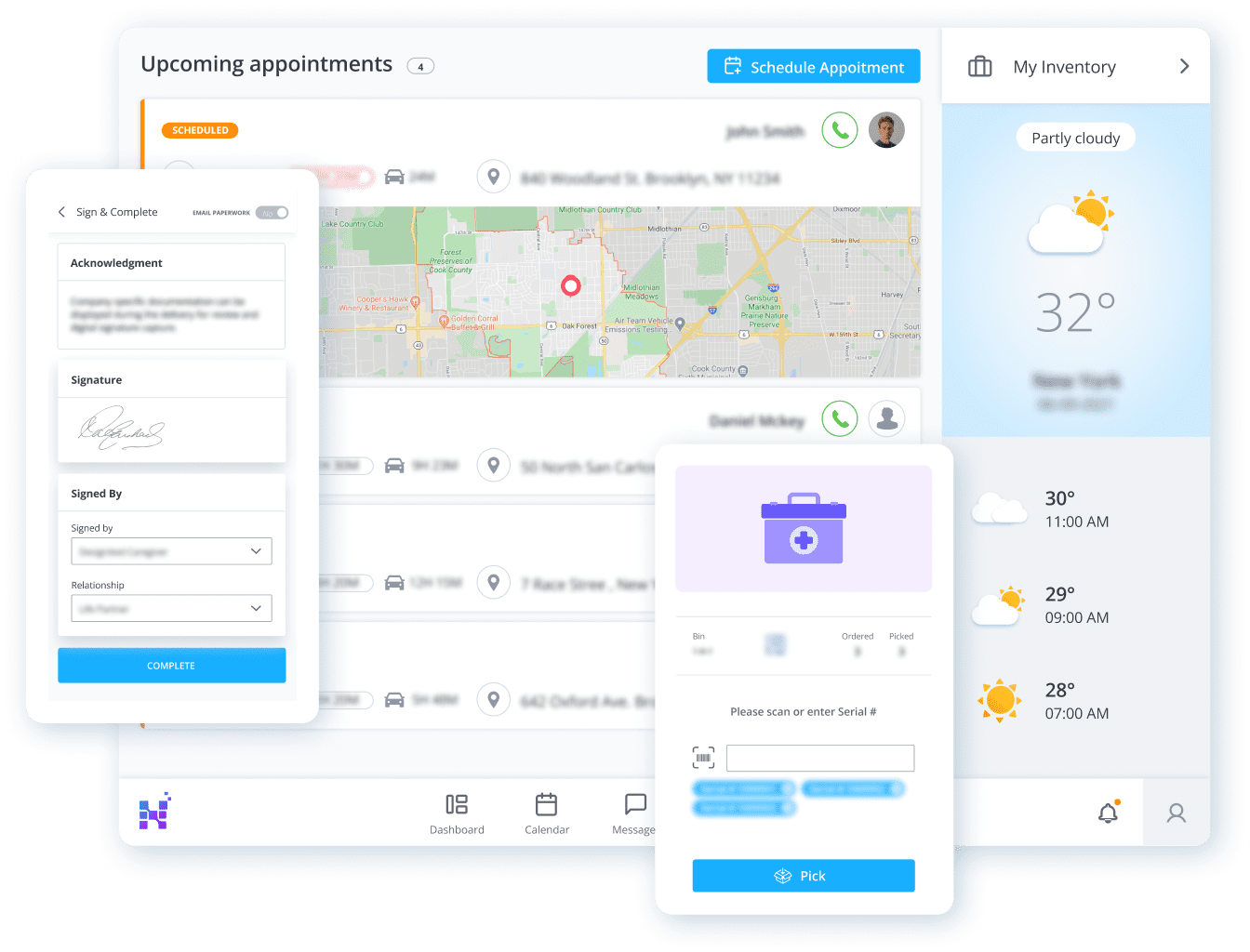
One of the biggest variables in how quickly a new DME technician becomes productive is the quality of the tools they’re given on day one. Legacy systems that require training themselves — slow interfaces, unclear workflows, no mobile access — extend the ramp-up period and introduce documentation errors during the learning curve.
Modern HME/DME software changes that. When your platform guides technicians through each step of the delivery process — surfacing the right order details, prompting for required documentation, and capturing e-signatures in the field — it reduces dependence on memory and minimizes the errors that new hires are most likely to make.
How NikoHealth Supports Technician Onboarding
NikoHealth’s mobile delivery app (iOS and Android) gives field technicians real-time access to order details, patient information, and delivery checklists — without needing to call the office for updates.
Key capabilities that reduce new-hire errors:
• Paperless e-signature capture at the point of delivery
• Real-time order status updates synced between field and office
• Role-based workflows that guide technicians through required steps
• Inventory visibility so technicians know what’s been picked and what’s staged
• Delivery confirmation that feeds directly into billing workflows
When documentation flows automatically from delivery into the billing system, a new technician’s learning curve stops creating revenue cycle problems.
Beyond the delivery app, your operations team benefits from real-time order visibility — the ability to see delivery status, flag exceptions, and track technician activity without waiting for end-of-day paper returns. That visibility is what turns a manager from a firefighter into a coach, and it makes new hire supervision practical rather than reactive.


Related Articles