


 26:51 to watch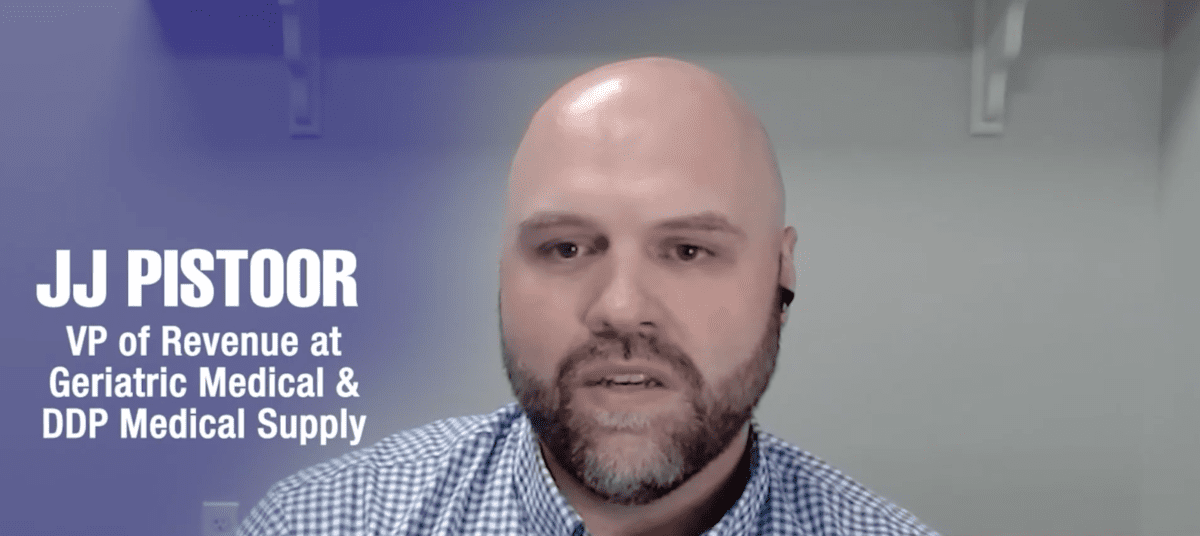
In this episode of the Claim to Fame Podcast, Alex and Wayne engage in a detailed conversation with JJ Pistoor, Vice President of Revenue at Geriatric Medical and DDP Medical Supply. JJ shares his professional journey from the rental car business to spearheading revenue operations at two prominent companies in the medical supply and distribution industry.
What You’ll Take Away
He delves into the core values and agile strategies that differentiate Geriatric Medical and DDP Medical, including their customer-first approach and emphasis on flexible, tailored solutions. The discussion covers the challenges of scaling a national distributor while maintaining personal touch, the integration of technology in the DME space, and the future of medical supply distribution. JJ also provides insights into the importance of cultural development within organizations and the critical role of relationship-building in healthcare distribution.
Podcast Transcription
- Podcast Episode: Scaling Healthcare Distribution Without Losing the Human Touch
- Guest:JJ Pistoor, Vice President of Revenue at Geriatric Medical
- Hosts: Alex & Wayne (NikoHealth)
(0:00) Introduction — Who Is JJ Pistoor?
JJ Pistoor joins the Claim to Fame podcast as Vice President of Revenue for Geriatric Medical and DDP Medical Supply. In his own words, it’s a fancy title for being responsible for everything customer-facing: sales, marketing, customer service and success teams, and even the company website. It’s a role he’s grown into over many years at Geriatric Medical, and one that expanded significantly with the recent acquisition of DDP Medical Supply, a nationwide distributor based in Saint Petersburg, Florida, with a strong focus on diabetes products and continuous glucose monitoring.
(2:20) A Winding Path Into Medical Supply
JJ is candid that selling incontinence and urology products into the healthcare space wasn’t exactly the childhood dream — but it’s where the road led, and he wouldn’t have it any other way. Out of college, he entered the rental car industry, going through an intensive management training program and eventually running the area just south of Boston for one of the major rental car companies. That experience — high-pressure, fast-paced, requiring quick thinking and accountability from day one — turned out to be an unexpectedly strong foundation for everything that followed.
From there, he transitioned into the medical space, working for one of the large manufacturers as a sales representative. It was in that role that he first encountered Geriatric Medical as a customer, and what he saw impressed him: a company that was agile, genuinely responsive, and focused on doing right by its customers. That culture was something he wanted to be part of, and he eventually made the move. The rest, as he puts it, is history.
(3:50) From Medtronic and Cardinal Health to a More Agile Model
Having worked with — and alongside — giant organizations like Medtronic and Cardinal Health early in his career, JJ has a clear-eyed view of what large companies do well and where they fall short. The scale, the innovation, and the institutional resources are undeniable. But agility isn’t their strong suit. The bigger the organization, the more red tape, the slower the response, and the harder it becomes to craft truly tailored solutions for individual customers.
Geriatric Medical, and now DDP, occupy a different position: smaller, more nimble, and built around the idea of meeting customers where they are. That means fewer layers of approval, faster problem-solving, and a genuine willingness to adapt to a customer’s operating model rather than asking the customer to adapt to theirs. JJ sees this as both a core value and a durable competitive advantage — one that aligns naturally with the providers they serve, who are themselves often agile, relationship-driven businesses trying to do right by their patients.
(4:54) From Account Manager to VP of Revenue: The Bigger Shift
When asked about the biggest shift in moving from managing accounts to leading an entire revenue organization, JJ points back — somewhat unexpectedly — to his rental car days. That environment, he says, was essentially business boot camp: you came in green, learned fast, handled everything yourself, and were held accountable in real time. The post-acute DME world operates with a similar energy. It’s the wild West in the best sense — relationship-driven, fast-moving, and demanding creative problem-solving rather than formulaic execution.
Those early experiences of grinding through difficult situations, thinking on his feet, and building skills from the ground up gave him the core competencies that eventually allowed him to grow into a VP-level role. He credits the specificity of that early hustle — the same kind of cold-calling-all-day grind that Alex and Wayne relate to from their own early careers — as the foundation that made everything else possible.
(7:43) What Makes Geriatric Medical Different After 80 Years
Geriatric Medical has been in business for roughly 80 years — a remarkable run in any industry, and especially in one as challenging as healthcare distribution. JJ attributes the longevity to two core values that have remained consistent throughout: a genuine customer-first mentality, and the ability to meet customers where they are.
The customer-first orientation isn’t just a slogan. It shows up in how the company makes decisions, how it structures its offerings, and how it thinks about growth. And the commitment to flexibility — to molding the company’s approach around the customer’s needs rather than the other way around — is what keeps relationships strong even as the business scales. JJ notes that this philosophy resonates strongly with what he’s seen from NikoHealth as well: a willingness to adapt to the realities of diverse customer tech stacks and operational models, rather than demanding that customers conform to a rigid platform.
(9:18) Scaling a National Distributor Without Losing the Personal Touch
Maintaining a personal, service-driven relationship with customers as you scale nationally is one of the most difficult problems in distribution — and JJ is honest that it’s something Geriatric Medical is actively working through right now. The acquisition of DDP brought significant new scale and geographic reach, particularly in the diabetes and continuous glucose monitoring space, and integrating that into the existing sales, marketing, and go-forward strategy is a daily challenge.
One structural decision that helps preserve the personal touch: Geriatric Medical doesn’t have a billing arm. This is intentional. By staying out of the billing business, the company signals clearly to its DME customers that it is not competing for their patients or their revenue — it’s there to support them. JJ uses the analogy of the trash collectors at Disney World: ideally, you barely notice they’re there, but everything stays pristine because of the work they’re doing quietly in the background. That’s the role Geriatric Medical aims to play — invisible to the end patient, indispensable to the provider.
(11:06) Building Culture Across Two Companies
JJ describes himself as a natural culture builder — not because he’s applied a deliberate framework to it, but because it’s simply how he shows up. He thinks of it as the sales instinct in him: always looking to be energizing, positive, and focused on shared wins. But he’s quick to give credit to the environment around him. Culture is easier to build when you’re surrounded by people who are already aligned — who feel the excitement of a win and the sting of a loss together. At Geriatric Medical, that’s the foundation he walked into, and it’s made everything else more natural.
The challenge now is preserving and extending that culture as DDP integrates and the combined organization grows. It’s a work in progress, but one JJ approaches with the same philosophy: focus on the people, keep the values clear, and trust that good culture compounds over time.
(12:11) Technology Trends Shaping DME Over the Next 3–5 Years
JJ resists defaulting to “AI” as the headline trend — not because he dismisses the technology, but because he believes the more useful question is: what specific problems can technology solve for our customers? That reframe, he says, keeps the conversation grounded in real operational needs rather than buzzword adoption.
What does genuinely excite him is the level of investment flowing into the DME space right now. Compared to other segments of post-acute care, the DME world is seeing meaningful attention from technology developers and investors — new platforms, new solutions, new integrations. That’s not happening everywhere in post-acute, and JJ sees it as a sign that the industry is being taken seriously as a space worth building for. The providers who learn to leverage these tools thoughtfully will have a significant edge.
(14:16) Will Technology Replace the Human Element in DME?
JJ’s view on this is nuanced and experience-driven. In the acute care world — large hospitals with contract-driven supply chains and high-volume, standardized orders — there’s substantial room for automation, and a lot of efficiency gains still to be captured. But in the post-acute space, the dynamic is fundamentally different. You’re not shipping pallets to a loading dock; you’re delivering a box to someone’s home. The patients are often vulnerable, the situations are personal, and the providers need to know there’s a human being on the other end of the line when something goes wrong.
That said, JJ sees technology as a powerful equalizer — particularly for the long tail of small and independent DMEs that make up so much of the market. AI and automation won’t eliminate the need for people, but they will reduce the army of back-office staff required to process claims, manage resupply orders, and keep operations running. That levels the playing field in a meaningful way, giving smaller providers access to capabilities that previously required scale to afford. The key insight: you won’t be replaced by AI, but you may be replaced by someone who knows how to use it.
(17:00) DDP Medical Supply: The Diabetes Distribution Arm
DDP Medical Supply was acquired by Geriatric Medical in mid-2024, and it brings a distinct and compelling focus to the combined organization. DDP is one of the top continuous glucose monitoring wholesalers in the country, operating in a product category that sits at the bleeding edge of healthcare technology and is proven to improve patient outcomes.
The model is built around white-label drop shipping: DDP fulfills orders on behalf of DME providers, delivering directly to patients’ homes in packaging that looks as though it came from the provider’s own warehouse. The patient never knows DDP was involved. That invisibility is by design — the goal is for the provider to get all the credit, all the patient relationship, and all the loyalty, while DDP handles the logistics quietly and reliably in the background.
(18:48) Geriatric Medical: Skilled Nursing and the New England DME Market
On the Geriatric Medical side of the business, the company’s strongest presence is in the skilled nursing market, where it operates as the largest distributor to skilled nursing providers in the New England region. It also works extensively with DME providers across New England, and holds a particularly meaningful position in Massachusetts, where it serves as the preferred incontinence supplier for MassHealth — the state’s Medicaid program. That means working with a large network of providers to deliver incontinence products directly to patients’ homes, a program Geriatric Medical has operated for years and takes considerable pride in.
JJ is also active in industry advocacy, sitting on the Medical Supplies Council at AAHomecare and working closely with organizations like the Home Care Alliance. He sees advocacy not as a side project but as a core responsibility — the DME industry has real policy challenges to navigate, and the providers fighting for fair reimbursement and appropriate regulation deserve to have distributors standing alongside them.
(19:51) Expansion Plans: From Regional to National
DDP already ships nationwide, but Geriatric Medical’s incontinence distribution is currently concentrated in the New England region. The team is actively building out the infrastructure to expand — developing a Midwest distribution center and working toward a West Coast presence as well. Incontinence is a high-volume, bulky product category that demands a physical distribution network to ship cost-effectively, so building out that footprint is the foundational step required before national scale becomes realistic. JJ describes this as one of the genuinely exciting things on the horizon for the combined business.
(20:52) What Keeps JJ Excited About the Space
Beyond the technology narrative, what truly energizes JJ about the DME space is the community of people in it. He’s had the opportunity to get close to provider networks regionally — through the Home Care Alliance board, through AAHomecare’s Medical Supplies Council — and what he sees is a group of people who care deeply about the industry and the patients it serves. The advocacy work being done in Washington, the tight-knit relationships between regional providers and their distributors, the sense of shared mission that extends well beyond any individual company’s bottom line — all of it points to an industry that has real people at its core, fighting for something that matters.
That, he says, is what makes it easy to come to work every day.
(22:13) What Does Medical Supply Distribution Look Like in 5–10 Years?
JJ’s outlook for the next decade is grounded and human-centered. He doesn’t see a world where robots replace relationships in post-acute care — the service component is simply too personal, the patient populations too vulnerable, and the provider relationships too nuanced to automate away. What he does see is a world where automation handles the repetitive, high-volume, back-office work — claims processing, resupply order management, contract optimization — and frees up people to focus on the higher-value, relationship-driven work that actually differentiates great DMEs from average ones.
The providers who figure out how to sweep the corners with technology — handling everything that can be automated cleanly and efficiently — will have the most capacity to invest in the personal touch that the post-acute world will always require. That’s where the competitive advantage will be built in the years ahead.
(23:56) Rapid Fire Round
Ship 1,000 orders yourself or sit through a four-hour Zoom that could have been an email? Ship the 1,000 orders — that feels way more productive.
Coffee or Red Bull before a big pitch? Celsius, actually — tactically better for your breath in a face-to-face situation.
If not in DME, what would you be selling — luxury cars or hot dogs at a baseball park? Hot dogs at a baseball park. That’s more his speed.
Explain what a DME distributor does at a dinner party, or assemble IKEA furniture with missing screws? Explain the DME business — and for what it’s worth, IKEA furniture has gotten a lot better than it used to be.
Always being early or always being right? Always being early.

Explore More Episodes