


 37:05 to watch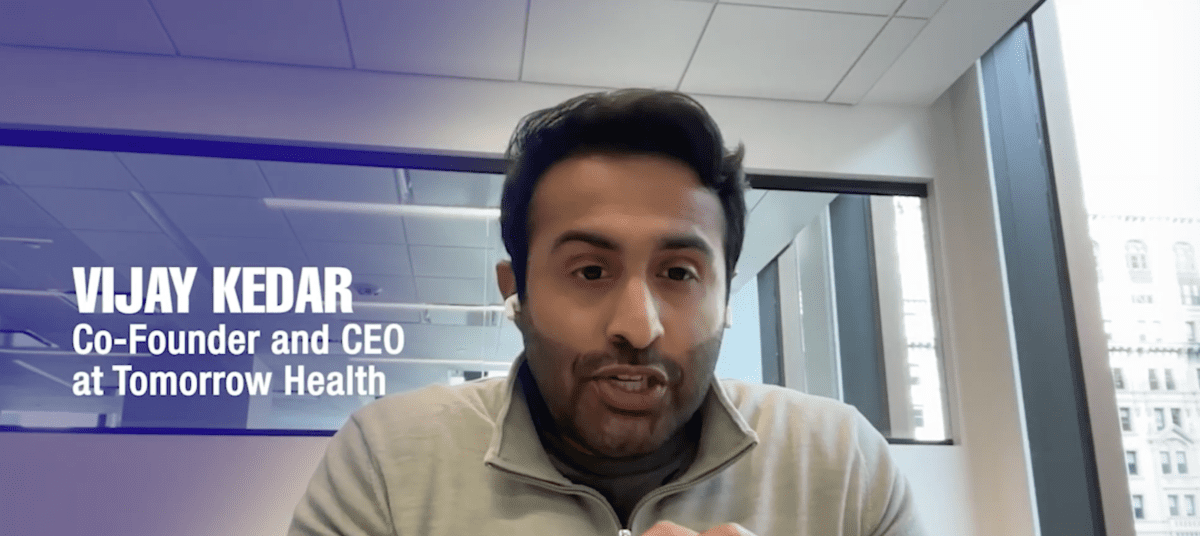
In this episode of the Claim to Fame podcast, Alex and Wayne welcome Vijay Kedar, co-founder and CEO of Tomorrow Health, who delves into his journey from investing in healthcare to founding a company that aims to revolutionize home-based care.
What’s Covered?
Vijay shares personal experiences that inspired the creation of Tomorrow Health and discusses the challenges patients face in receiving home-based care. He explains how his company leverages AI to streamline administrative processes, reduce inefficiencies, and improve patient experiences. Vijay also offers insights into the future of home-based care and the significant impact AI can have on the healthcare ecosystem. The episode wraps up with a rapid-fire Q&A session, revealing Vijay’s key metrics, productivity habits, and thoughts on healthcare system efficiency.
Podcast Transcription
Podcast Episode: Transforming Home-Based Care
Guest: Vijay Kedar, co-founder and CEO of Tomorrow Healt
Hosts: Alex & Wayne (NikoHealth)
Episode Introduction
We as a country are shifting toward a greater degree of care at home. But it’s become clear that the home-based care ecosystem lacks the technology and infrastructure to operate efficiently.
Today, we’re excited to welcome Vijay Kedar, Co-Founder and CEO of Tomorrow Health, to talk about how technology, especially AI, can transform home-based care.
Welcome to the Podcast
Alex:
We are live on the Claim to Fame podcast, and today we have a very special guest, Vijay Kedar from Tomorrow Health. Welcome to the show!
Vijay:
Thanks, guys. Great to be here.
Wayne:
Happy New Year and welcome!
Vijay:
Happy New Year — new year, new us.
Vijay’s Background & Journey
Alex:
For listeners who may not know you, tell us a bit about your background and your company.
Vijay:
I grew up in Pittsburgh in a large family of physicians — I joke that I was pre-med out of the womb.
I began my career investing in healthcare and healthcare technology, then spent several years at Oscar Health as it grew from 20 employees to over 2,000 and served more than a million members nationwide.
Tomorrow Health was founded about six years ago, inspired by a deeply personal experience: helping manage my mother’s home-based care. She was a stage-three cancer patient who developed lung disease from chemotherapy and spent months in the ICU. When she came home, she needed everything — oxygen, wound care, mobility equipment, therapy, supplies — and coordinating that care was incredibly difficult.
We experienced firsthand how broken the process was: faxing forms, managing authorizations, coordinating with multiple physicians, troubleshooting equipment failures. We even had to readmit her to the hospital twice in the first month.
That experience, combined with what I saw at Oscar — patients stuck in hospitals for days due to DME delays — made it clear that while healthcare is shifting toward care at home, the infrastructure simply wasn’t built to support it.
The Gap in Home-Based Care
Alex:
You’ve seen this from both the payer side and operational side. What gap did you notice that others were missing?
Vijay:
Seeing the system from multiple vantage points helped reveal the real pain points.
Today, you can order almost anything online and have it delivered in under 48 hours. But getting life-saving medical equipment to patients is incredibly complex. Why?
Two core problems stood out:
Administrative complexity in reimbursement rules
There are 3,500+ HCPCS codes, 100,000+ products, and wildly different rules across thousands of insurers. That complexity creates bottlenecks everywhere.Manual, analog workflows
Too many interactions are still handled by fax, phone calls, and tribal knowledge rather than digitized systems.
When everything is manual, you get delays, errors, inefficiencies, and financial strain for every stakeholder.
The “Love Triangle” of Healthcare
Alex:
One of our former guests called it the healthcare love triangle — providers, payers, and suppliers. It’s hard to make everyone happy.
Vijay:
Exactly. You can’t just serve one customer in healthcare. Solutions must deliver value to all stakeholders:
- Ordering providers
- DME suppliers
- Health plans
That reality shaped how we built Tomorrow Health.
What Tomorrow Health Actually Does
Wayne:
How should DME providers think about Tomorrow Health? Are you a network, a platform, or something else?
Vijay:
We’re a technology platform that improves the ecosystem for all participants.
For Ordering Providers
We make ordering DME dramatically easier and faster.
Our original e-prescribe product reduced ordering from 90 minutes to about 10–15 minutes.
But we pushed further with Horizon AI Ordering, where a provider can drag-and-drop patient documentation and complete an order in under 60 seconds on average. Provider retention on this platform is over 99%.
For Suppliers
We provide:
- Clean digital orders
- Fewer documentation issues
- Higher-quality referrals
- Growth opportunities with new payers
Suppliers using our platform report:
- 95% of orders are clean and actionable
- 25–30% reduction in operating expenses
- Some partners have doubled or tripled their volume
For Payers
We help absorb the complexity of coverage rules, prior auth requirements, and reimbursement logic — reducing the burden on suppliers and providers.
Fax Automation & Omni-Channel Order Management
Vijay:
We heard consistently from suppliers:
“Even if digital ordering improves, we still get tons of fax orders.”
So we built AI-powered fax automation that:
- Digitizes faxed orders
- Extracts data using computer vision
- Identifies missing info
- Requests missing documentation
- Converts it into a clean digital order
The goal is true omni-channel order management — one platform that handles everything.
Where Providers Struggle Most
Alex:
Where do you see DME providers struggling the most right now?
Vijay:
Order intake remains the biggest pain point.
Then:
- Fax management
- Prior authorizations
- Denials and audits
- Getting paid reliably
And at a strategic level:
How do I position my company in an era of competitive bidding, narrowing networks, and increasing consolidation?
What Excites Vijay About the Future
Wayne:
What excites you most about the next 3–5 years?
Vijay:
Three things:
1. Agentic AI Transformation
We believe we’re in the early innings of AI fundamentally reshaping DME operations.
We’ve built AI agents that automate tasks like:
- Order management
- Communication with providers and patients
- Status updates
- Documentation workflows
Internally, we’ve reduced manual touchpoints by over 70% using these agents. Our supplier partners are now seeing similar results.
2. Transforming the Patient Experience
We want to go beyond back-office efficiency and improve the patient experience through:
- Better education
- 24/7 AI support for troubleshooting
- Proactive communication
- Improved adherence for therapies like CPAP
Technology can dramatically improve quality of life for patients.
3. Expanding Beyond DME
DME is just one piece of home-based care. The same inefficiencies exist in other services delivered in the home. Our long-term vision is to expand technology-driven coordination and quality improvement across broader home-based care.
Redesigning the Healthcare System
Alex:
If you could redesign one part of the healthcare system overnight, what would it be?
Vijay:
Payment structure.
The fragmented system — Medicare, Medicare Advantage, Medicaid, commercial, all with different rules — creates massive complexity and inefficiency. It leads to intermediaries, misaligned incentives, and administrative burden across the entire ecosystem.
A more unified, streamlined insurance structure would reduce complexity and improve outcomes across healthcare.
Rapid Fire Q&A
First word that comes to mind when you hear “home-based care”?
→ Inefficient
One metric you obsess over?
→ Supplier satisfaction
If Tomorrow Health didn’t exist, what would keep you up at night?
→ Administrative complexity in healthcare payments
Favorite productivity habit as a CEO?
→ Protecting focus time; doing more with fewer meetings
Early morning meetings or late-night Slack messages?
→ Unfortunately… both

Explore More Episodes