


 39:10 to watch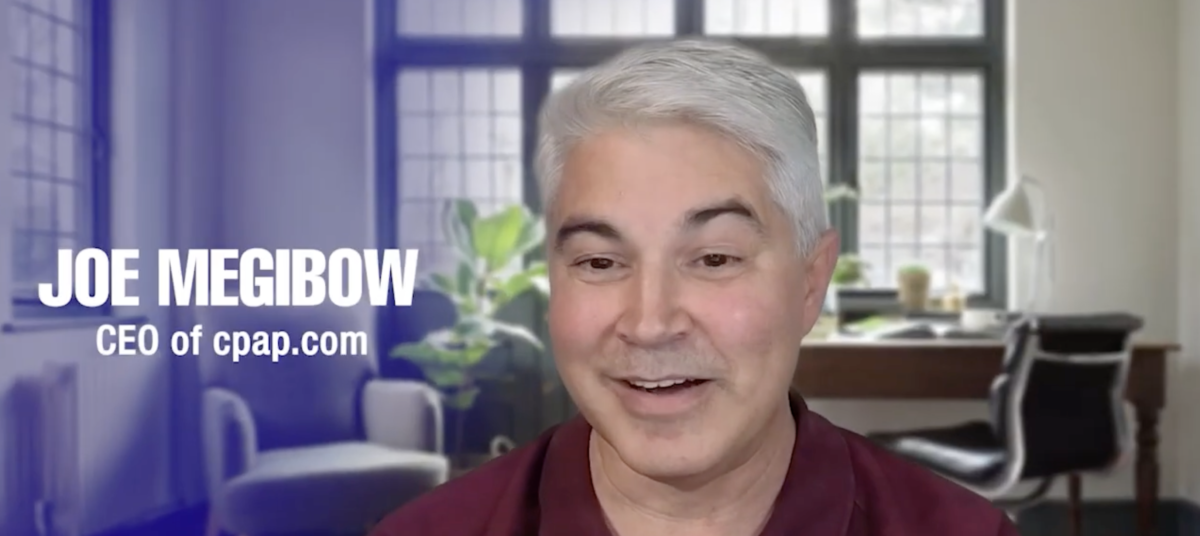
In this episode of the Claim to Fame Podcast, Alex and Wayne interview Joe Megibow, CEO of cpap.com.
What’s Covered?
Joe shares his journey from being a technologist in the automotive sector to leading consumer-centric retail and travel companies. He speaks about his deep-rooted passion for sleep health, his transition to running cpap.com, and how the company is addressing the challenges and opportunities in the sleep apnea market. Joe elaborates on his approach to turning around businesses, the importance of unit economics, and the innovative strategies cpap.com is using to simplify patient experiences and drive market demand. He also offers insights into how digital experiences and AI are reshaping the healthcare landscape and shares his vision for the future of sleep therapy. Wrapping up, Joe participates in a rapid-fire round on various topics including morning routines, sleep quality, and the challenges of earnings calls.
Podcast Transcription
- Podcast Episode: Transforming Sleep Health with Joe Megibow
- Guest: Joe Megibow, CEO of cpap.com
- Hosts: Alex & Wayne (NikoHealth)
(0:00) Introduction — Who Is Joe Megibow?
Joe Megibow introduces himself as the current CEO of CPAP.com, a role he stepped into just over six months prior to the recording. His background is rooted in technology — he started out as a software engineer in the automotive sector before the internet era took hold. He later co-founded a software startup focused on maximizing consumer experience, which was eventually acquired by IBM.
From there, Joe shifted into large-scale consumer retail and travel, taking senior digital roles at recognizable names like Expedia.com and American Eagle Outfitters. His path into sleep health began when he ran Purple Mattress — a company he describes as a true disruptor, notable not just for selling mattresses online but for manufacturing a proprietary technology that originally emerged from the medical side of sleep, including wheelchair cushions and beds for burn victims. He then led Casper Sleep before discovering his passion for sleep health research and eventually joining CPAP.com.
(1:41) From Engineering to Consumer Experience
When asked what drew him from a technical career into consumer-facing businesses, Joe reflects on a pivotal moment during business school (1994–96). He stumbled into data-driven marketing and was immediately captivated by the idea that data could be used to predict and influence consumer behavior. As a technically minded person, the fusion of analytics and marketing felt revolutionary — “data and marketing in the same sentence” wasn’t something he expected to encounter.
He went on to co-found Tea Leaf, a company that deepened his interest in interaction design, human factors, and the psychology of consumer behavior. These experiences — combining engineering thinking with consumer empathy — became the foundation of his entire career. He explains that consumer businesses are uniquely honest: customers vote with their wallets every single day, and if you’re listening closely enough, they tell you exactly what’s working and what isn’t.
(5:03) What Joe Looks for in a Turnaround
Joe’s last several leadership roles have been defined as turnarounds — companies with strong fundamentals that had lost their footing. His first diagnostic question is always about unit economics: is there actually a good business buried underneath the problems? If the core product-market fit is solid, the challenge is usually one of overhead, poor resource allocation, or misaligned execution — and those are fixable.
At CPAP.com specifically, the unit economics were strong from the outset. The business had been around for 25 years, had grown significantly, and had been acquired by private equity. But the competitive landscape had shifted — particularly with changes in the supplier base for CPAP machines — and the company needed a new playbook. Six months in, Joe reports that the business has returned to meaningful growth and is on what he describes as an impressive trajectory.
(11:32) CPAP.com vs. Traditional DME Models
One of the podcast hosts notes that CPAP.com was one of the original self-pay leaders in the DME space — so novel, in fact, that NikoHealth’s team once tried to sell them their billing software, only to learn that CPAP.com didn’t bill insurance at all.
Joe clarifies a few common misconceptions. CPAP.com does accept HSA and FSA payments, which is a meaningful benefit for many patients. Additionally, a significant portion of their customers are actually insurance-covered patients who are being underserved by the traditional system — for example, patients who need a travel CPAP machine (a product insurance won’t cover) or a backup device for a second home. He points out that for some patients, the cumulative out-of-pocket cost of copays and deductibles over 18 months through insurance can actually exceed the cost of buying directly from CPAP.com — which also offers 0% financing over 12 months.
When it comes to the competitive question — is CPAP.com a threat to traditional DMEs? — Joe reframes the conversation entirely. There are an estimated 30 million US adults living with obstructive sleep apnea, but only around 6 million are currently being treated. That means four out of five people with the condition are completely unserved. To him, the real challenge isn’t competing for existing patients — it’s expanding the market altogether.
(19:07) Demand Generation: CPAP.com’s Core Differentiator
Traditional DME acquisition relies heavily on physician referrals — a relationship-driven, inbound model. Joe respects that approach, but observes that doctors are not in the business of demand generation. They service existing demand; they don’t create it.
CPAP.com, by contrast, has built its entire business around demand generation — reaching people who may not yet know they have sleep apnea, may not understand their options, or may have been too intimidated by the healthcare system to take action. Joe draws a parallel to pharmaceutical advertising: while some campaigns (like Ozempic) do successfully move consumer behavior, most top-of-funnel health advertising has limited impact on deeply entrenched awareness gaps. Sleep apnea is one of those gaps — and CPAP.com is uniquely positioned to close it.
(21:45) Reimagining the Patient Digital Experience
Joe’s vision for a world-class digital experience in sleep health starts with empathy. Sleep disorders are uniquely difficult to self-diagnose because the condition occurs while you’re unconscious. Many people hear about it from a partner — snoring is a common indicator — but have never asked whether they snore themselves. Others attribute their exhaustion to lifestyle issues rather than recognizing disrupted sleep as the primary cause.
He describes the ideal CPAP.com experience as one where friction is systematically removed at every step. Their evolving home sleep testing offering is a prime example: ideally, a patient swipes a credit card, a device shows up at their door, the test runs automatically, and the next conversation they have is with a clinician helping them understand their results and begin their treatment journey — with no prior authorizations, no scheduling delays, no confusing referral chains.
Joe uses the Warby Parker analogy: a highly convenient, well-branded experience where the patient feels in control, the process is simple, and the price is transparent. He adds that the company is also developing a new brand — Sleeping.com — specifically designed to reach the much larger, earlier-stage audience of people who know something is wrong with their sleep but don’t yet know what a CPAP is.
(29:13) Wearables, AI, and the Future of Sleep Diagnosis
The conversation turns to wearable technology — specifically how devices like Apple Watch and Oura Ring, which now include sleep apnea detection features, could act as triggers that drive people toward diagnosis and treatment. Joe welcomes this development enthusiastically. Anything that raises awareness and motivates people to seek answers is good for the category. But he flags a critical gap: awareness alone isn’t enough. The “now what?” question — once someone suspects they have a problem — is where the system breaks down for most people. If CPAP.com can be the clear, trustworthy answer to that question, they have a significant opportunity.
(31:49) AI Reshaping the Patient Journey
When asked how AI will reshape patient journeys over the next five years, Joe is measured but optimistic. He sees AI most immediately as an accelerant for automation — enabling workflows and customer service capabilities that would otherwise be economically prohibitive. He gives a specific example: he recently spoke with a regional DME that was struggling to expand into a new state because insurance companies have little appetite to onboard new DME providers, given how high the operating costs are relative to near-term returns. AI, he believes, has the potential to fundamentally change that equation by reducing the operational burden of onboarding and servicing patients at scale.
He also sees significant AI opportunity on the insurance side of the business — though he acknowledges that some institutional bottlenecks (such as fax-based document workflows and manual paperwork) require structural changes that AI alone cannot solve. Still, he expects AI to enable real disruption in the category.
(34:29) What Does Sleep Therapy Look Like in 2030?
Joe invokes a Bill Gates quote: we tend to overestimate progress in the near term and underestimate it in the long term. He applies this framework honestly — the CPAP industry operates in three-to-four-year cycles, and regulatory timelines mean that fundamental treatment modalities probably won’t look radically different by 2030. But the disruptions he’s describing — demand generation at scale, streamlined digital patient journeys, AI-powered operations — will have begun to take root.
He expects to see new players gaining real traction, forcing the broader industry to decide whether to adapt or risk being disrupted. Just as ChatGPT emerged as a disruptive force while Google and Microsoft scrambled to respond, the sleep health space will see similar dynamics play out. The structural inefficiencies are too significant and the unmet need too large for things to remain static.
(36:51) Rapid Fire Round
Morning routine — optimized for efficiency or still in beta? Optimized for efficiency.
Five-star review or five-point margin gain? A five-star review — in consumer, that comes with the margin gain anyway.
CPAP therapy theme song — Dream On or Don’t Stop Believin’? Dream On — both internally and externally, it’s where the company is right now.
Eight hours of sleep forever or always wake up energized on five? Five hours of truly restorative, uninterrupted sleep — quality over duration, every time.
First earnings call as a CEO or first night sleeping with a CPAP mask? First earnings call as a public company CEO, without question.
(38:48) How to Connect with Joe Megibow
Joe invites anyone who wants to reach out to find him on LinkedIn. He’s active there and welcomes conversations with people in the DME and sleep health space.

Explore More Episodes