



How to Start a Home Healthcare Business: The Full Process
The process of starting a home healthcare agency spans legal formation, state licensing, Medicare certification, staffing, and operational setup. Each step builds on the last. Skipping or rushing any phase creates compliance exposure that’s difficult to reverse once you have patients on service.
Here is the sequence most new agency owners follow:
Startup Phase | Key Action | Estimated Timeline |
Business formation | Register LLC or corporation, obtain EIN | 1–2 weeks |
Licensing & accreditation | Apply for state home health license, Medicare certification | 60–120 days |
Home healthcare business plan | Define services, financial projections, staffing model | 2–4 weeks |
Insurance & compliance | Secure liability, workers’ comp, and malpractice coverage | 2–3 weeks |
Staffing | Hire RNs, CNAs, and care coordinators; verify credentials | 4–8 weeks |
Software & billing setup | Implement HME/home health platform, configure billing | 2–4 weeks |
Marketing & referrals | Build referral network with hospitals and physicians | Ongoing |
The timeline from initial registration to Medicare-certified operations typically runs four to six months for a straightforward startup. Multi-state launches or agencies targeting specialized populations (pediatrics, behavioral health) can take longer.
Build Your Home Healthcare Business Plan First
Before filing a single form, you need a home healthcare business plan that reflects the actual economics of your market. A business plan for a home health agency is more than a financial projection — it’s an operational blueprint that shapes every hiring, technology, and payer contracting decision you’ll make in year one.
A complete home healthcare business plan should address:
- Service scope: Will you provide skilled nursing, physical therapy, personal care, or a combination? Medicare-certified agencies must meet specific conditions of participation.
- Geographic coverage area: Your staffing model, vehicle costs, and response times are all determined by the territory you define at the start.
- Payer mix strategy: Medicare and Medicaid reimbursement rates differ significantly from private pay. Most agencies target a blend. Your plan should model cash flow under each payer scenario.
- Staffing structure: Define the ratio of RNs, LPNs, CNAs, and care coordinators you’ll need to cover your projected patient census in the first 12 months.
- Technology and billing infrastructure: Home health billing under Medicare’s PDGM (Patient-Driven Groupings Model) is complex. Your plan should account for software costs and billing staffing from day one.
Lenders, investors, and even some state licensing boards will ask to see your business plan. Treat it as a live document, not a one-time formality.
Licensing Requirements for Starting a Home Healthcare Agency
Licensing for home healthcare agencies is regulated at the state level. Every state has its own requirements, and in some states (New York, California, Illinois) the process is competitive or cap-restricted, meaning the number of new agency licenses issued in a given year is limited.
Most states require:
- A state home health agency license, which involves an application, background checks on owners and administrators, and a site survey
- Proof of professional liability and general liability insurance before the license is granted
- An administrator of record who meets the state’s minimum qualification requirements (typically an RN or licensed healthcare administrator)
Medicare certification is a separate process, managed through the Centers for Medicare & Medicaid Services (CMS). To bill Medicare, your agency must pass a state health department survey confirming compliance with the Conditions of Participation. Most agencies submit their Medicare enrollment application (Form CMS-855A) in parallel with state licensing, since CMS surveys are scheduled after state licensure is confirmed.
If you plan to accept Medicaid, you’ll need to separately enroll in your state’s Medicaid program, which has its own provider agreement and credentialing requirements.
Staffing Your Home Healthcare Agency
Staffing is where most new home health agencies either build a competitive advantage or create their largest recurring problem. Home health staffing is tight in most markets. Competition for experienced RNs and CNAs is intense, and agencies that start without a clear recruitment and retention strategy find themselves unable to grow their patient census.
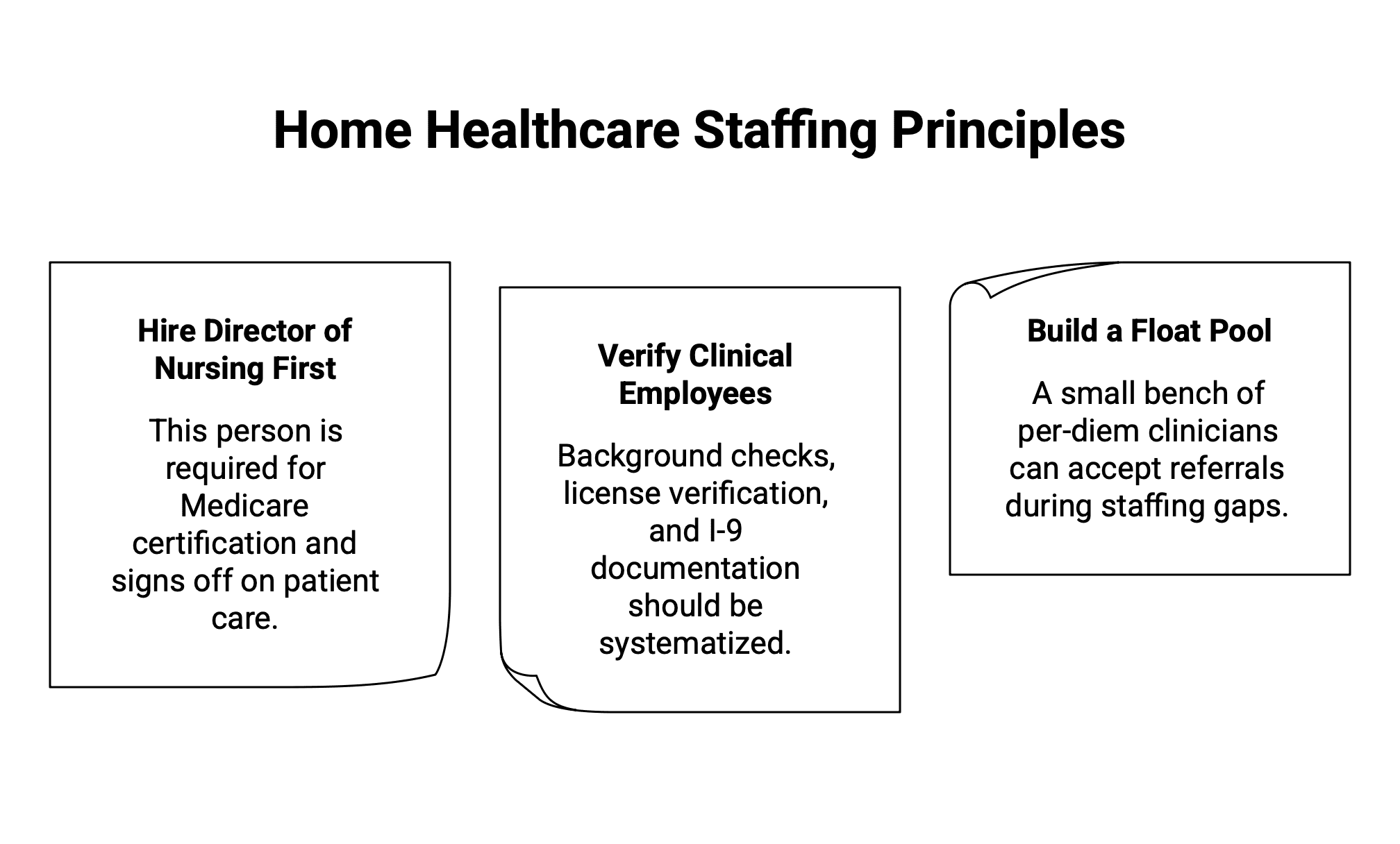
Consider these principles when building your initial team:
- Start with your Director of Nursing or clinical lead hire first Every Medicare-certified agency requires a qualified Director of Nursing. This person also signs off on patient plan-of-care documents, so they need to be in place before you take your first patient.
- Credential verify every clinical employee before their first shift Background checks, license verification, and I-9 documentation should be systematized from day one — not managed manually.
- Build a float pool before you need it Patient census will fluctuate. Agencies that have a small bench of per-diem clinicians can accept referrals without turning away business during staffing gaps.
Staff turnover in home health is one of the strongest predictors of agency performance. Competitive pay, reliable scheduling, and clear communication channels matter more than most owners expect in the first year.
Home Healthcare Franchise Opportunities vs. Independent Startups
Home healthcare franchise opportunities offer an alternative path for entrepreneurs who want the structure and brand recognition of an established network. Major home health and home care franchises operate across the US and provide training, technology, marketing support, and sometimes payer contracts as part of the franchise package.
Benefits of franchise models
Franchises reduce startup ambiguity. You receive an operating system, a brand, and training resources that would otherwise take years to develop. Some franchises also provide centralized billing support, which is valuable for owners who don’t have a healthcare billing background.
Drawbacks to evaluate
Franchise fees and ongoing royalties reduce margin. Most home healthcare franchise opportunities charge an upfront fee between $50,000 and $150,000, plus royalties of 4–7% of gross revenue. Franchisees also operate within a defined territory and may have limited flexibility to expand services or enter new payer contracts without franchisor approval.
The right choice depends on your capital position, your tolerance for uncertainty, and whether you have existing experience in healthcare operations. Operators with strong clinical or billing backgrounds often find the independence of starting their own agency worth the additional complexity. First-time healthcare entrepreneurs tend to benefit from the guardrails a franchise provides.
Billing and Software: Setting Up for Reimbursement Success
Home health billing is more complex than most new agency owners anticipate. Medicare reimbursement under PDGM is episode-based, split into 30-day periods, and adjusted based on patient clinical groupings, functional impairment, and comorbidities. Getting claims right from the first submission requires both trained billing staff and software that validates claims before they reach the payer.
Agencies that underinvest in billing infrastructure in their first year face three predictable problems:
- High denial rates from preventable coding errors on OASIS documentation
- Delayed cash flow from manual remittance posting, creating a cash gap between service delivery and payment
- Compliance exposure from inadequate documentation on plans of care and physician certifications
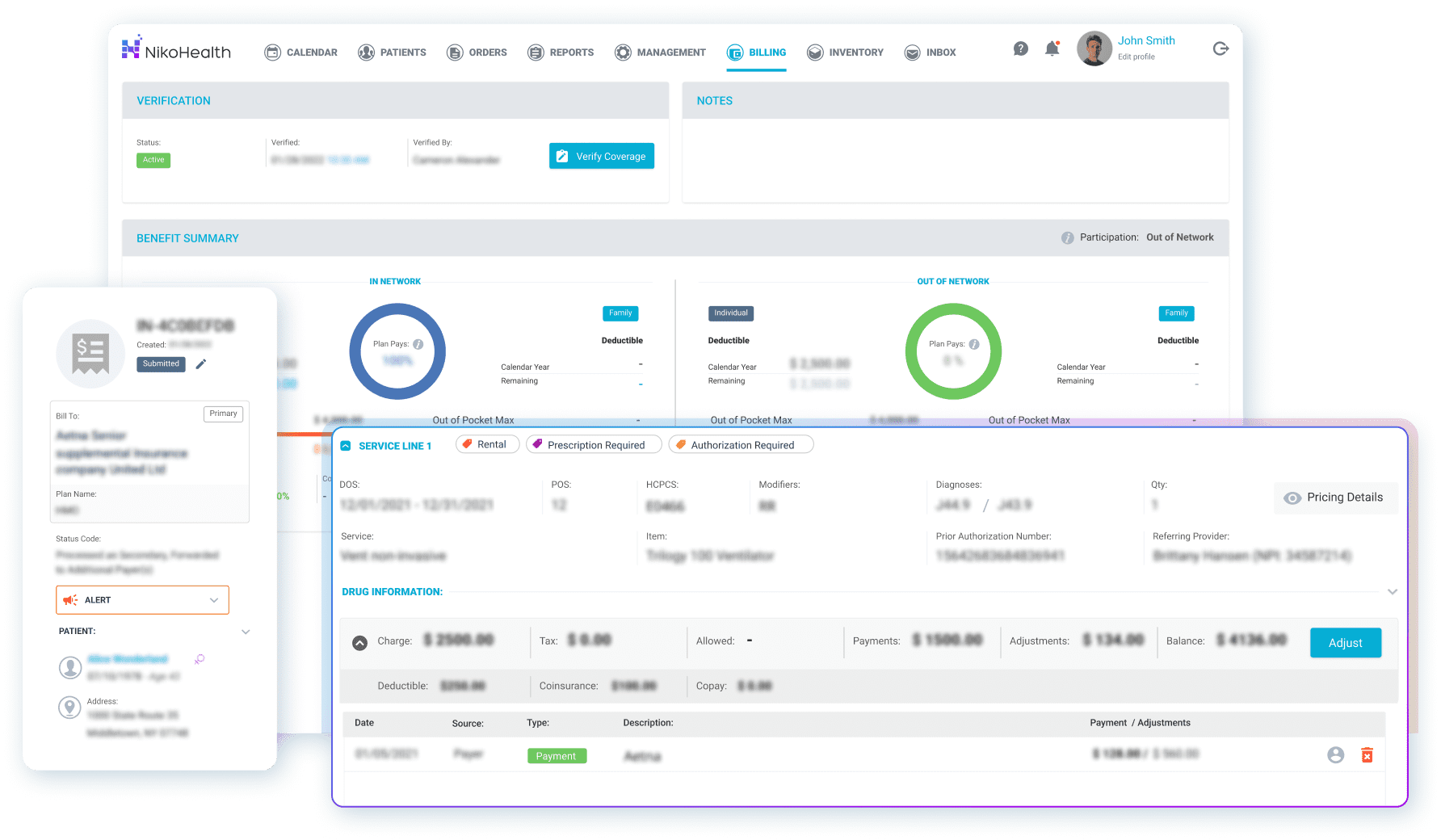
Purpose-built home health and HME/DME software platforms address these problems systematically. Automated eligibility verification at intake, claim scrubbing before submission, and automated ERA/EOB posting all reduce the manual burden on billing staff and accelerate collections.
NikoHealth is designed specifically for this environment, consolidating billing, patient management, and operational reporting into a single platform that grows with your agency.
Your technology infrastructure should be decided during business planning, not after you’ve already taken patients. Retrofitting billing software onto a growing census is significantly more disruptive than setting it up before day one.
Frequently Asked Questions
How much does it cost to start a home healthcare business?
Startup costs for an independent home healthcare agency typically range from $70,000 to $200,000, depending on state licensing fees, initial staffing, insurance premiums, and technology costs. Home healthcare franchise opportunities require additional upfront franchise fees, usually $50,000 to $150,000.
How long does it take to get Medicare certified?
Medicare certification typically takes four to six months from initial application to the first approved claim. The timeline includes state licensing, a CMS enrollment application, and a state health department survey. Delays are common if application materials are incomplete.
Do I need clinical experience to start a home healthcare agency?
You do not need a clinical license to own a home healthcare agency in most states, but you do need a licensed clinical administrator — typically a Director of Nursing — who meets state-defined qualifications. Many successful agency owners come from business, operations, or finance backgrounds and hire clinical leadership as their first key hire.
What is the best software for a new home healthcare agency?
New agencies should look for a platform that handles Medicare billing under PDGM, automated eligibility verification, plan-of-care documentation, and remittance posting in one system. NikoHealth provides all of these in a cloud-based platform purpose-built for home health and HME/DME providers, with structured onboarding support designed for agencies setting up from scratch.


Related Articles