



Durable Medical Equipment (DME) plays a critical role in modern healthcare by helping patients manage chronic conditions, recover from injuries, and maintain independence at home. Behind every wheelchair delivery, oxygen setup, or CPAP machine is a specialized business known as a DME provider.
If you’re exploring opportunities in healthcare entrepreneurship or expanding an existing medical business, understanding what is a DME provider, the true DME provider meaning, and how to become a DME provider is essential.
This guide explains the role of a DME provider, outlines the step-by-step path to entering the industry, and highlights how technology can help you operate efficiently and compliantly in 2026 and beyond.
- Learn what a DME provider is and why it plays a critical role in modern healthcare
- Understand the DME provider meaning, responsibilities, and types of DME businesses
- Follow a step-by-step guide on how to become a DME provider
- Discover how automation and NikoHealth help streamline and scale DME operations
What Is a DME Provider?
A DME provider is a healthcare supplier that furnishes patients with durable medical equipment prescribed by a licensed healthcare professional. These providers operate at the intersection of clinical care, logistics, and healthcare reimbursement.
To fully understand what is a DME provider, it’s helpful to start with the DME provider meaning itself.
A DME provider supplies medical equipment that:
Is designed for repeated use
Serves a medical purpose
Is appropriate for use in the home
Is prescribed by a physician or other qualified provider
Common examples of DME include:
Wheelchairs and walkers
Oxygen equipment and supplies
CPAP and BiPAP devices
Hospital beds and patient lifts
Orthotics, prosthetics, and certain wound care products
DME provider meaning goes beyond simply selling equipment. A DME provider ensures patients receive the correct equipment, meets payer requirements, manages billing and compliance, and often provides education, setup, and ongoing support.
What Does a DME Provider Do?
To fully answer what is a DME provider, it’s important to understand the wide range of responsibilities involved. A DME provider is not simply a supplier of medical equipment — it’s a critical operational partner in patient care, responsible for ensuring that prescribed equipment is delivered safely, compliantly, and in accordance with payer requirements.
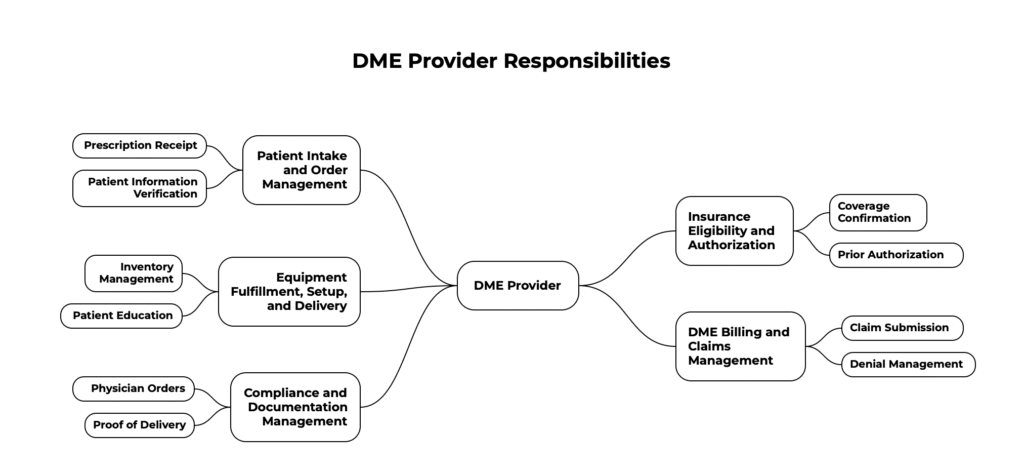
Patient Intake and Order Management
DME providers receive prescriptions and referrals from physicians, hospitals, or discharge planners, then collect and verify patient demographic, clinical, and insurance information. This intake process sets the foundation for accurate fulfillment and reimbursement. Errors at the patient intake management can lead to delayed care or claim denials.
Insurance Eligibility and Authorization
Before equipment is delivered, DME providers must confirm that the patient’s insurance coverage is active and that the prescribed equipment is covered under the patient’s plan. This includes determining patient financial responsibility and securing prior authorizations when required by Medicare, Medicaid, or commercial payers. Accurate eligibility verification is essential to prevent unpaid claims and unexpected patient costs.
Equipment Fulfillment, Setup, and Delivery
Once coverage is confirmed, the DME provider manages inventory, coordinates delivery logistics, and ensures proper setup of equipment in the patient’s home. Many providers also educate patients and caregivers on safe usage, maintenance, and troubleshooting. This hands-on role directly impacts patient outcomes and satisfaction, especially for complex equipment such as oxygen systems or mobility devices.
DME Billing and Claims Management
DME providers submit claims to Medicare, Medicaid, or commercial insurers using HCPCS Level II codes and payer-specific modifiers. This process includes managing rentals, recurring billing, claim denials, appeals, and payment posting. Because DME billing rules are highly specific and frequently updated, this area requires specialized knowledge and continuous monitoring.
Compliance and Documentation Management
DME providers are responsible for maintaining complete and accurate documentation, including physician orders, certificates of medical necessity, proof of delivery, and audit-ready records. Regulatory oversight of DME suppliers is significant, and incomplete or inconsistent documentation can trigger audits, recoupments, or loss of billing privileges.
Types of DME Providers
Not all DME providers operate the same way. Understanding these different business models helps clarify what is a DME provider across various care settings and explains how services, workflows, and patient interactions can vary widely within the DME industry.
While each type serves a distinct role, all DME providers share the same foundational responsibility: delivering medically necessary equipment in a compliant, timely, and reimbursable manner.
Retail DME Providers
Retail DME providers operate physical storefronts where patients can walk in to purchase or rent medical equipment directly. These providers often serve patients who require standard or short-term equipment, such as walkers, crutches, braces, or bathroom safety products.
Retail providers typically focus on:
Point-of-sale transactions
Cash-pay or limited insurance billing
Immediate equipment availability
In-person customer service and education
While their billing complexity may be lower than other models, retail DME providers must still comply with supplier standards and documentation requirements when billing insurance.
Home Medical Equipment (HME) Providers
Home Medical Equipment (HME) providers specialize in delivering equipment directly to patients’ homes. This model is increasingly important as healthcare shifts toward home-based and post-acute care.
HME providers manage:
Home delivery and setup
Patient education and training
Long-term equipment rentals
Ongoing maintenance and resupply
These providers often support patients with chronic conditions, making long-term compliance, recurring billing, and strong patient relationships central to their operations.
Specialty DME Providers
Specialty DME providers focus on specific clinical categories or patient populations. Rather than offering a broad product catalog, they develop deep expertise in targeted areas such as sleep therapy, respiratory care, mobility solutions, or orthotics and prosthetics.
Common characteristics include:
Highly specialized equipment and accessories
Complex documentation and medical necessity requirements
Close coordination with prescribing physicians
Frequent follow-ups and monitoring
Specialty providers often face higher regulatory scrutiny due to the complexity and cost of the equipment they supply.
Institutional or Contracted DME Providers
Institutional or contracted DME providers work directly with hospitals, skilled nursing facilities, rehabilitation centers, or home health agencies. These providers are often part of discharge planning workflows and help ensure continuity of care after a patient leaves a facility.
This model emphasizes:
Contract-based service agreements
Tight delivery timelines
Integration with clinical workflows
High-volume, standardized processes
Institutional DME providers must be highly efficient, compliant, and technologically integrated to meet partner expectations and payer requirements.
Type of DME Provider | Primary Focus | Typical Services | Billing Complexity | Common Patients |
Retail DME Providers | In-store sales and rentals | Walk-in equipment purchase, basic fittings | Low to Moderate | Short-term or self-pay patients |
HME Providers | Home-based care | Delivery, setup, training, rentals, resupply | High | Chronic and post-acute patients |
Specialty DME Providers | Clinical specialization | Sleep, respiratory, mobility, orthotics | High | Condition-specific populations |
Institutional Providers | Facility partnerships | Discharge support, bulk fulfillment | Moderate to High | Hospital and facility patients |
How to Become a DME Provider: Step-by-Step
If you’re researching how to become a DME provider, it’s important to understand that the process involves far more than sourcing equipment and finding patients. Becoming a DME provider requires careful planning, regulatory compliance, payer enrollment, and operational readiness. Each step builds on the previous one, and skipping or rushing any stage can delay approval or impact reimbursement.
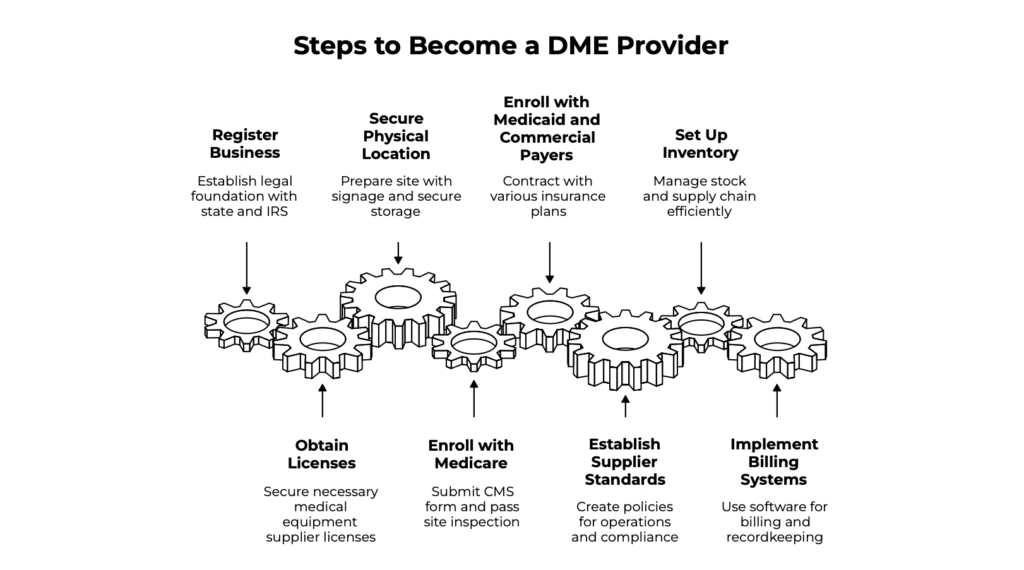
Step 1: Register Your Business
The first step in how to become a DME provider is formally establishing your business. This includes selecting a legal structure such as a limited liability company (LLC) or corporation and registering the business with your state. You will also need to obtain an Employer Identification Number (EIN) from the IRS, which is required for tax reporting, banking, and payer enrollment. A properly registered business creates the legal foundation needed to move forward with licensing and insurance contracting.
Step 2: Obtain Required Licenses
Licensing requirements vary by state, but most states require DME providers to hold a medical equipment supplier license or a similar healthcare-related permit. Depending on the type of equipment you plan to offer, additional licenses may be required. This step is foundational to how to become a DME provider legally, as operating without proper licensure can lead to application denials or future compliance issues. It is critical to review state-specific regulations early in the process.
Step 3: Secure a Physical Location
Most payers, including Medicare, require DME providers to operate from a physical location that meets specific standards. The location must have proper exterior signage, regular business hours accessible to the public, and secure storage for equipment and patient records. Site inspections are commonly conducted during enrollment, and failing to meet location requirements is a frequent reason applications are delayed or denied. Preparing your location in advance is a key milestone in how to become a DME provider.
Step 4: Apply for Medicare DMEPOS Enrollment
Medicare enrollment is one of the most critical steps in how to become a DME provider. To enroll, you must submit CMS Form 855S, obtain a surety bond, and pass a site inspection. You must also demonstrate compliance with all Medicare supplier standards. Approval allows you to bill Medicare for covered DME items and is often required before commercial payers will complete their own enrollment processes.
Step 5: Enroll With Medicaid and Commercial Payers
After Medicare approval, the next step is enrolling with Medicaid and commercial insurance plans. Each payer has its own application process, contract requirements, and reimbursement schedules. This stage can take several months and often requires submitting documentation already used during Medicare enrollment. Successfully contracting with multiple payers expands patient access and is a critical revenue component for any new DME provider.
Step 6: Establish Supplier Standards and Internal Policies
DME providers are required to maintain written policies that govern daily operations and compliance. These policies typically cover delivery procedures, equipment setup, complaint handling, emergency service availability, and documentation retention. Clear, well-documented policies support compliance, prepare your organization for audits, and help ensure consistent service delivery. This step reinforces the operational discipline required in how to become a DME provider.
Step 7: Set Up Inventory and Supply Chain Operations
Inventory and supply chain decisions play a major role in operational efficiency. New DME providers must determine whether to stock inventory on-site, rely on drop-shipping from manufacturers, or manage recurring resupply programs for long-term patients. Each approach has cost, storage, and workflow implications. Effective inventory management ensures timely fulfillment while minimizing waste and cash flow strain.
Step 8: Implement DME Billing and Software Systems
The final step in how to become a DME provider is implementing systems that support billing, documentation, and compliance from day one. Efficient eligibility verification, claims management, and recordkeeping are essential to preventing denials and delayed payments. Many new providers struggle at this stage if they rely on manual processes or disconnected tools. Implementing purpose-built DME software early helps streamline workflows, reduce errors, and support long-term scalability.
How NikoHealth Can Help You Automate All DME Processes
Whether you are just learning how to become a DME provider or looking to scale an established operation, having the right technology platform is essential.
NikoHealth is an all-in-one, cloud-based HME/DME software solution designed to support every stage of the DME provider journey — from intake to billing to long-term growth.
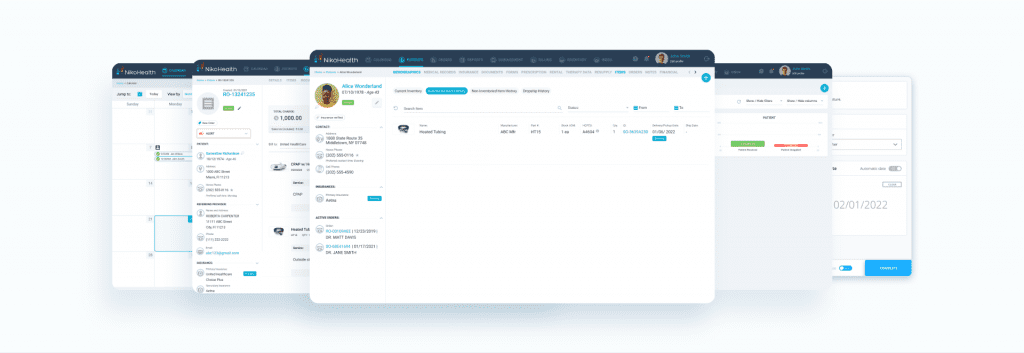
With NikoHealth, DME providers can:
Automate DME billing and claims management to ensure clean, compliant claims and faster reimbursement
Verify insurance eligibility in real time, reducing denials and write-offs before delivery
Manage prior authorizations, rentals, and recurring billing with payer-specific automation
Centralize documentation to stay audit-ready and compliant
Improve collections with patient estimates, automated statements, and integrated payments
Gain actionable insights through robust analytics and reporting
By replacing disconnected tools and manual processes with a unified platform, NikoHealth helps DME providers operate more efficiently, scale confidently, and focus on delivering exceptional patient care.

Conclusion
So, what is a DME provider? At its core, a DME provider is a vital link between clinical care and patient independence. Understanding the full DME provider meaning requires recognizing the balance of care coordination, compliance, logistics, and revenue cycle management involved.
If you’re considering how to become a DME provider, success depends on preparation, compliance, and the right operational foundation. As the industry continues to evolve, providers that embrace automation and integrated technology will be best positioned to grow, stay compliant, and deliver better outcomes for patients.
If you’re ready to simplify operations and automate your DME workflows, NikoHealth is built to support your journey — today and into the future.
 Abby Rapcienski">
Frequently Asked Questions
What is a DME provider?
A DME provider is a healthcare supplier that furnishes durable medical equipment prescribed by a qualified clinician. The role goes beyond selling a device: the provider coordinates patient intake, insurance verification, documentation, inventory, delivery, setup, education, billing, maintenance, and ongoing support. It operates at the intersection of clinical care, logistics, reimbursement, and compliance.
What responsibilities does a DME provider have before delivery?
Before fulfillment, the provider collects and verifies patient, clinical, and insurance information; confirms eligibility; calculates patient responsibility; obtains prior authorization when required; and checks that the order and medical-necessity documentation are complete. These steps protect the patient from delays and unexpected costs while reducing the provider’s risk of an unpaid or denied claim.
What happens after a DME provider confirms coverage?
The provider allocates the correct equipment, coordinates delivery, sets it up in the patient’s home, and teaches the patient or caregiver how to use and maintain it safely. The business then submits the claim with the appropriate HCPCS codes and payer-specific modifiers and manages rentals, recurring billing, denials, appeals, payments, and audit-ready records.
What kinds of businesses can operate as DME providers?
DME businesses can use several models, including retail storefronts, insurance-focused suppliers, specialty providers, and operations that deliver complex equipment to the home. Their product mix and billing complexity differ, but each is responsible for delivering medically necessary equipment safely, on time, with the documentation and supplier standards required by the applicable payer.

Related Articles