



What Is DME Medical Billing? An Overview
Durable Medical Equipment (DME) refers to medical equipment that:
- Can withstand repeated use
- Serves a medical purpose
- Is generally not useful to someone who is not sick or injured
- Is appropriate for use in the home
Examples include wheelchairs, walkers, oxygen equipment, CPAP machines, hospital beds, and infusion pumps. Under Medicare, DME is grouped with prosthetics, orthotics, and supplies as DMEPOS.
DME billing is the process of submitting claims to payers such as Medicare, Medicaid, and commercial insurers to get paid for supplying these items. It differs from routine medical billing in three ways. It uses HCPCS Level II codes rather than CPT codes. Many items are paid as monthly rentals rather than one-time purchases. And payment depends on documentation from the ordering practitioner that the supplier does not control but must collect and keep.
For Medicare, DME claims are processed by four regional DME MACs, assigned by where the beneficiary lives. Suppliers bill under their own Medicare supplier number and PTAN (Provider Transaction Access Number), not the ordering physician’s.
DME Billing Terms and Codes to Know
Term | What it is | Why it matters for billing |
HCPCS Level II codes | Alphanumeric codes (for example, E0601 for a CPAP device) that identify the item supplied | The wrong or outdated code is one of the most common causes of denial. CMS updates codes quarterly. |
Modifiers | Two-character codes added to a HCPCS code, such as NU (new purchase), RR (rental), UE (used purchase), KX (coverage criteria met), and KH, KI, KJ (capped rental months) | Tell the payer how the item was supplied and whether policy requirements are met. Missing or wrong modifiers cause denials. |
Standard written order (SWO) | The order from the treating practitioner, with the patient name, order date, item description, quantity, and practitioner name and NPI | Required for every Medicare DMEPOS claim. Some items need it before delivery. |
Face-to-face encounter | A documented visit with the ordering practitioner within six months before the order | Required before delivery for items on CMS’s Required Face-to-Face Encounter and Written Order Prior to Delivery List. |
Prior authorization | Payer approval requested before the item is delivered | A condition of payment for items on the Medicare Required Prior Authorization List and for many commercial plans. |
A form that certified medical necessity for certain items, such as oxygen | Medicare eliminated CMNs and DIFs for dates of service on or after January 1, 2023. Some Medicaid and commercial payers still ask for them. See our CMN guide. | |
Capped rentals | Items Medicare pays as monthly rentals for up to 13 continuous months, after which the patient owns the item | Each month must be billed with the right rental modifier. Breaks in service affect the count. |
Oxygen payment cap | Medicare pays oxygen equipment rental for 36 months | After 36 months the supplier keeps furnishing the equipment for the rest of its five-year reasonable useful lifetime, without rental payments. |
What Is Changing in DME Billing for 2027
Several Medicare changes finalized in 2025 and 2026 take full effect in 2027, and more are proposed. These are the ones that affect billing teams most.
Annual DMEPOS Accreditation
The CY 2026 Home Health final rule requires DMEPOS suppliers to be resurveyed and reaccredited every year instead of every three years, effective January 1, 2026. A supplier’s annual cycle begins when its current three-year accreditation expires, so many suppliers will face their first annual survey during 2027. Surveys can be unannounced. Billing records, written orders, and proof of delivery must be audit-ready at all times. Our DMEPOS accreditation guide covers what surveyors check.
More Items Need Prior Authorization
CMS added seven HCPCS codes to the Required Prior Authorization List on April 13, 2026, including pneumatic compression devices E0651 and E0652. It added eight more on October 28, 2026: thoracic-lumbar-sacral orthoses L0456, L0457, and L0486, knee orthosis L1833, air-fluidized bed E0194, and ultralightweight manual wheelchair K0005 nationwide, plus elbow and wrist-hand orthoses L3761 and L3916 in a phased rollout. For these items, a claim without an approved prior authorization request is denied. See how to get DME prior authorizations approved faster.
Competitive Bidding Returns in 2028
CMS is restarting the DMEPOS Competitive Bidding Program as a nationwide Remote Item Delivery program for items usually shipped to patients. According to AAHomecare, Round 2028 covers seven product categories: Class II continuous glucose monitors (CGMs) and insulin pumps, urological supplies, ostomy supplies, hydrophilic urinary catheters, and off-the-shelf back, knee, and upper extremity braces. Contracts are expected to be awarded in late summer or early fall 2027 and to start no later than January 2028.
Once CGMs and insulin pumps are furnished under the program, Medicare will pay for all CGMs and insulin pumps on a monthly rental basis. Suppliers that bill these categories should plan for the 2028 transition during 2027, whether or not they win a contract.
Proposed for 2027: Replacement Items and Infusion Pumps
The CY 2027 Home Health proposed rule, published in July 2026, includes several DMEPOS changes.
- Replacement items. A new face-to-face encounter would not be required when an item is replaced with one under the same HCPCS code. A new order would still be required.
- Infusion pumps. Starting April 1, 2027, the DME benefit would expand to cover certain external infusion pumps, home infusion drugs, and supplies that do not meet the usual “appropriate for use in the home” standard, under set safeguards.
- Competitive bidding. Contract suppliers would report the country of origin for lead items.
- Provider enrollment. CMS proposed further enrollment safeguards, building on the CY 2026 rule that expanded the grounds for retroactive revocation.
The 2027 DMEPOS Fee Schedule
CMS updates the DMEPOS fee schedule every January and adjusts it quarterly. For CY 2026, most items not under competitive bidding received a 2.0% update, based on a 2.7% CPI-U increase minus a 0.7% productivity adjustment. Rates still vary by HCPCS code, patient ZIP code, and whether the area was a former competitive bidding area. Our Medicare DME fee schedule guide explains how to look up the right amount.
Heightened Audit and Compliance Focus
Medicare and other payers use data analytics to flag unusual billing patterns, which raises the chance of pre-payment review and post-payment audits. Combined with annual accreditation and expanded revocation authority, this makes documentation discipline a daily requirement. For a full checklist, see Medicare DME billing requirements.
Core Components of DME Billing
Every DME claim moves through the same core steps. The table below shows each step and what it depends on. The sections after it explain each one.
The DME Billing Process, Step by Step
Step | What happens | Key codes and documents |
1. Intake and order | The supplier receives a referral and collects the written order and clinical records | Standard written order, face-to-face encounter notes where required |
2. Eligibility verification | Coverage, deductibles, and same-or-similar equipment history are checked before delivery | Payer eligibility response, patient responsibility estimate |
3. Prior authorization | Approval is requested for items that require it | Prior authorization request and affirmation number |
4. Coding | The item is coded with the right HCPCS code and modifiers | HCPCS Level II code, NU, RR, UE, KX, KH, KI, KJ modifiers, ICD-10 diagnosis codes |
5. Delivery | The item is delivered and proof of delivery is captured | Signed proof of delivery or shipping record |
6. Claim submission | Claims are scrubbed for errors and submitted electronically | 837P claim to the DME MAC or payer |
7. Payment posting | Payments and adjustments are posted against each claim | ERA/EOB (Electronic Remittance Advice / Explanation of Benefits) |
8. Denial management | Denials are worked, corrected, or appealed, and root causes are tracked | Denial reason codes, redetermination requests |
9. Recurring billing | Rentals and resupply are billed on schedule | Rental month modifiers, refill documentation |
How NikoHealth Supports DME Billing for High-Volume Providers
As billing rules tighten, many suppliers reassess how they run revenue cycle operations. For large, multi-location DME providers, the question is how to keep claim accuracy high when volume, payer mix, and the number of branches all grow at once.
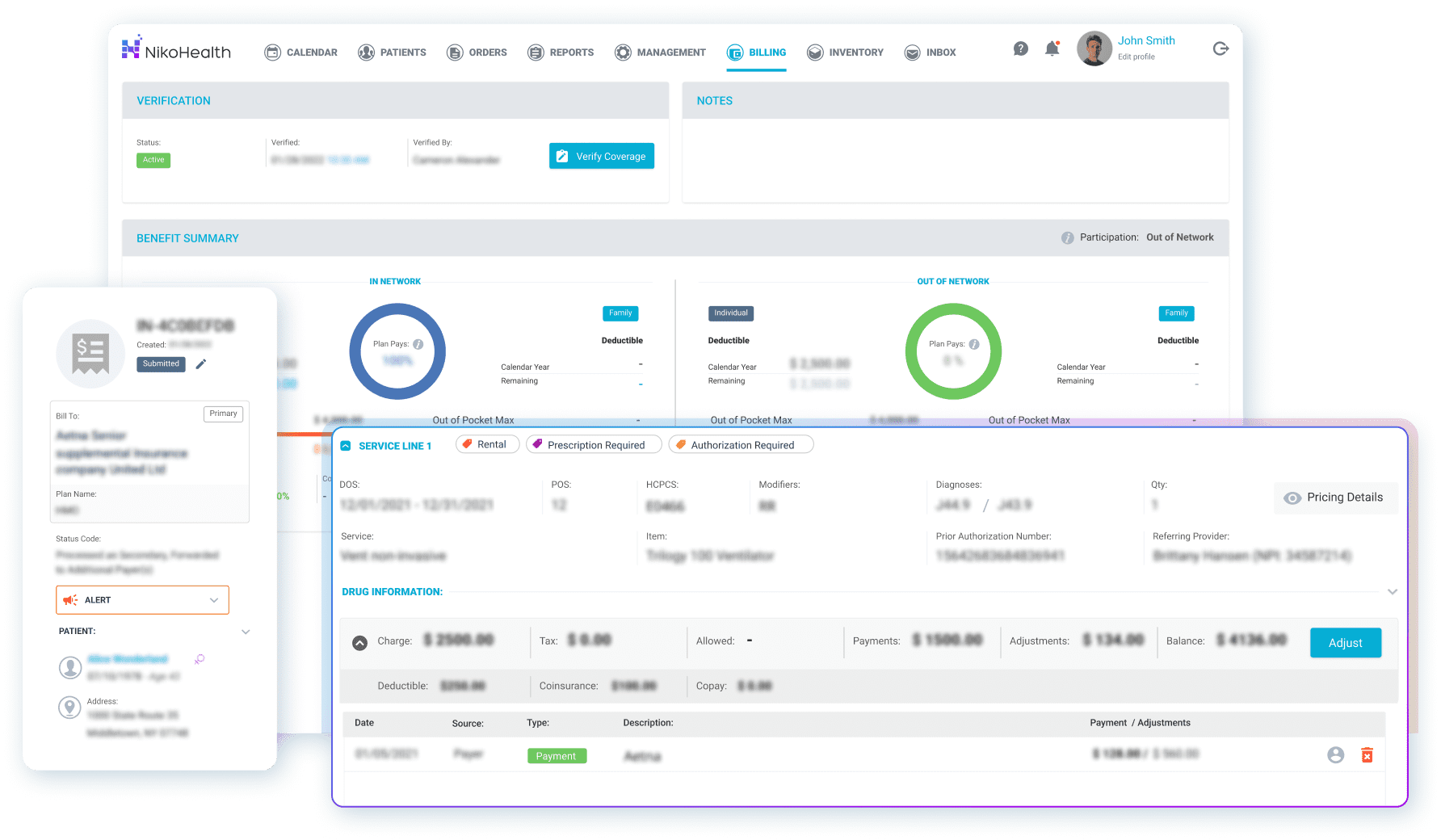
NikoHealth is a cloud-based platform built for HME and DME providers. It runs billing on the same data as intake, orders, delivery, and inventory, so claims start with complete information. With NikoHealth, billing teams can:
- Catch errors before submission with automated pre-submission claims scrubbing and a configurable payer rules engine
- Verify eligibility for commercial and government payers before fulfillment and claim submission
- Post ERA/EOB payments automatically instead of reconciling by hand
- Bill recurring rentals on schedule and work denials from one queue
- See claims, payments, denials, and outstanding balances across every location in real-time dashboards
Prime Care HME is one example. After moving to NikoHealth, payment posting went from about three hours a day to five minutes.
Frequently Asked Questions
What is DME billing?
DME billing is the process of submitting claims to Medicare, Medicaid, and commercial insurers for durable medical equipment that a supplier provides for home use, such as oxygen equipment, CPAP machines, wheelchairs, and hospital beds. Claims use HCPCS Level II codes and modifiers and must be supported by a written order, proof of delivery, and records showing medical necessity.
How is DME billing different from regular medical billing?
DME billing uses HCPCS Level II codes instead of CPT codes, pays many items as monthly rentals rather than one-time purchases, and depends on documentation from the ordering practitioner. Medicare DME claims go to one of four DME Medicare Administrative Contractors (DME MACs) rather than the contractor that processes physician claims.
What codes are used in DME billing?
DME claims use HCPCS Level II codes to identify the item, such as E0601 for a CPAP device. Modifiers add detail, including NU for a new purchase, RR for a rental, UE for a used purchase, KX when policy requirements are met, and KH, KI, and KJ for capped rental months. ICD-10 codes show the diagnosis that supports medical necessity.
Does Medicare still require a CMN for DME?
No. Medicare eliminated Certificates of Medical Necessity (CMNs) and DME Information Forms (DIFs) for claims with dates of service on or after January 1, 2023. Claims that include them are rejected. Medical necessity is now shown through the standard written order and the patient’s medical record. Some Medicaid and commercial payers still use CMNs.
Which DME items need prior authorization from Medicare?
Items on the Medicare Required Prior Authorization List need approval before delivery. The list includes certain power mobility devices, pressure-reducing support surfaces, orthoses, and pneumatic compression devices. CMS added seven codes on April 13, 2026 and eight more on October 28, 2026, including K0005 ultralightweight wheelchairs and E0194 air-fluidized beds.
What is changing in DME billing in 2027?
DMEPOS suppliers now need accreditation every year instead of every three years, and many will face their first annual survey in 2027. More items need prior authorization, and the Medicare Competitive Bidding Program returns in January 2028, with contracts expected to be awarded in 2027. CMS also updates the DMEPOS fee schedule each January.
Conclusion
DME billing is not just transaction processing. It combines clinical documentation, coding, regulatory compliance, and technology. In 2027, annual accreditation, expanding prior authorization, and the return of competitive bidding raise the stakes, and proactive suppliers will stand apart.
By automating error checks, staying current with code and policy changes, and investing in training and documentation discipline, your organization can protect revenue, keep patients supplied, and stay ready for audits.
If you would like help reviewing your DME billing workflow, the NikoHealth team is here to help.


Related Articles