


A DME license is a state-issued license or permit that allows a business to sell or rent durable medical equipment to patients in that state. There is no federal DME license. Each state sets its own rules, and in many states the license is issued by the Board of Pharmacy or the state health department. Several states also require a license from out-of-state suppliers that ship equipment to their residents.
Starting a durable medical equipment (DME) business, or expanding into a new state, usually starts with this question: do we need a state license, and how do we get it? This guide explains:
- what a DME license is and how it differs from accreditation
- which states require a DME license, with a state-by-state table
- how to apply, step by step
- typical DME license costs
- how long the process takes
What Is a DME License (and Do You Need One)?
A DME license is a legal authorization to sell, rent, or deliver durable medical equipment such as wheelchairs, oxygen equipment, CPAP machines, and hospital beds within a specific state. States use it to confirm that suppliers meet standards for safety, record-keeping, staffing, and accountability before they serve patients.
The license goes by different names. Florida, Illinois, and Kentucky call it a Home Medical Equipment provider license. California calls it a Home Medical Device Retailer license. North Carolina issues a Device and Medical Equipment permit, and Arizona issues a DME supplier permit.
A state license is separate from your federal requirements. To bill Medicare, a DMEPOS supplier must enroll in Medicare, hold accreditation from a CMS-approved accrediting organization, post a surety bond, and meet the Medicare supplier standards, which include complying with every applicable state licensing requirement. In practice, that means you need the state license (where one exists) before Medicare will enroll a location.
DME License Requirements by State
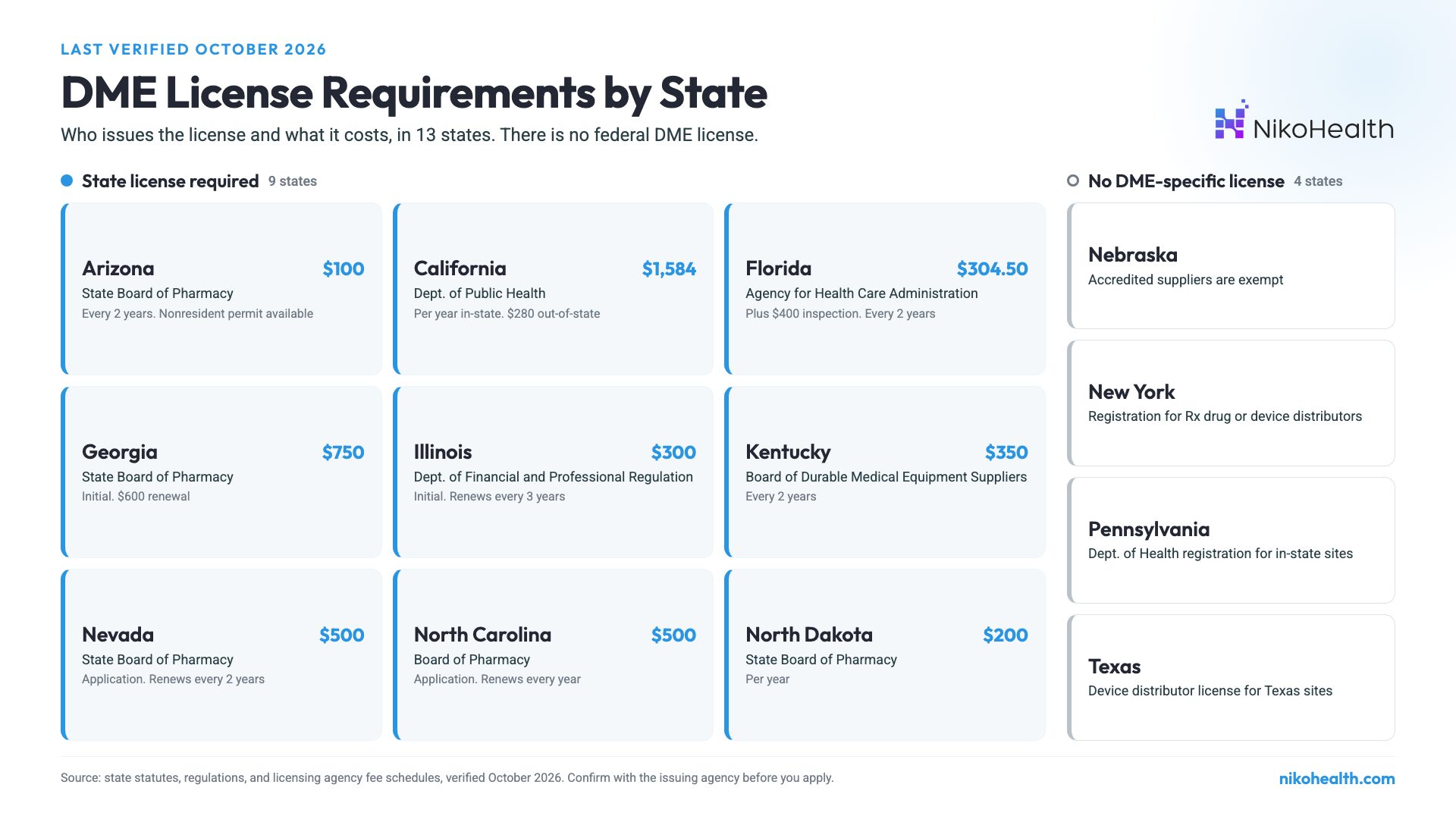
There is no single national DME license, and requirements change. The table below shows the current rules for 13 states, checked against each state’s statute, regulations, or licensing agency.
Last verified: October 2026. Fees and rules can change, so confirm with the issuing agency before you apply.
State | License required? | License and issuing agency | Out-of-state suppliers | Fees and renewal |
Arizona | Yes | Durable Medical Equipment and Compressed Medical Gas Supplier permit, Arizona State Board of Pharmacy | Yes, nonresident permit required to supply patients in Arizona | $100, renewed every two years |
California | Yes | Home Medical Device Retailer (HMDR) license, California Department of Public Health, Food and Drug Branch | Registration required if supplying prescription medical devices into California | $1,584 a year in-state, $280 a year out-of-state |
Florida | Yes | Home Medical Equipment Provider license, Agency for Health Care Administration (AHCA) | Yes, and out-of-state applicants must be accredited | $304.50 license fee plus $400 inspection fee, renewed every two years |
Georgia | Yes | Durable Medical Equipment Supplier license, Georgia State Board of Pharmacy | Limited. Out-of-state permits are available only to Medicare-enrolled suppliers that also hold a manufacturer or wholesaler license | $750 initial, $600 renewal |
Illinois | Yes | Home Medical Equipment and Services Provider license, Illinois Department of Financial and Professional Regulation (IDFPR) | Yes, separate out-of-state application | $300 initial, renewed every three years |
Kentucky | Yes | Home Medical Equipment and Services Provider license, Kentucky Board of Durable Medical Equipment Suppliers | Yes, with inspection outside Kentucky at actual cost | $350 initial, $350 renewal every two years |
Nebraska | No DME-specific license | Accredited suppliers are exempt from pharmacy and wholesale licensure when supplying devices or oxygen on a medical order | Not applicable | Not applicable |
Nevada | Yes | Medical Products Provider license for Medical Devices, Equipment and Gases (MDEG), Nevada State Board of Pharmacy | Yes, same application covers out-of-state facilities | $500 application fee, renewed every two years |
New York | No DME-specific license | No state DME license. Businesses that distribute prescription drugs or devices register with the NYS Education Department, Office of the Professions | Out-of-state shippers of prescription drugs or devices must register | Medicaid DME enrollment through eMedNY is separate |
North Carolina | Yes | Device and Medical Equipment (DME) permit, North Carolina Board of Pharmacy | Yes, and permit holders need a physical location in North Carolina or within 40 miles of its border | $500 application fee, registration renewed every year |
North Dakota | Yes | Durable medical equipment retailer license, North Dakota State Board of Pharmacy | Yes, plus registration with the North Dakota Secretary of State | $200 a year |
Pennsylvania | No DME-specific license | In-state businesses that handle medical devices register with the Pennsylvania Department of Health, Drugs, Devices, and Cosmetics program | Not required for out-of-state retail-only suppliers | Annual registration |
Texas | No DME-specific license | Texas locations that distribute medical devices need a device distributor license from the Texas Department of State Health Services (DSHS) | Out-of-state distributors are exempt | $495 to $1,731 per Texas location, based on device sales, renewed every two years |
Here are the patterns to understand before you apply.
Many States Require a License
Most of the states in the table require a license to supply DME to their residents. In several of them, the rule also applies to out-of-state suppliers that ship into the state.
- North Dakota law says an out-of-state DME retailer may not do business in the state unless it is licensed by the Board of Pharmacy and registered with the Secretary of State.
- Florida requires a Home Medical Equipment Provider license for anyone who holds itself out as providing HME to Florida patients, and out-of-state applicants must be accredited.
- Arizona requires a nonresident permit for any supplier that sells, leases, or supplies DME to a patient in Arizona for home use.
Some States Have No DME-Specific License
Nebraska, New York, Pennsylvania, and Texas do not issue a license specifically for DME suppliers. That does not mean there are no rules. Texas licenses medical device distributors with a location in Texas. Pennsylvania registers in-state businesses that handle drugs and devices. New York registers anyone who distributes prescription drugs or devices into the state. Nebraska exempts accredited suppliers from pharmacy licensure for devices and oxygen supplied on a medical order.
Always check general business registration, sales tax, and pharmacy laws as well, especially if you supply oxygen or prescription devices.
Different Agencies Oversee Licensing
In some states, the health department or a health care administration agency issues the license, such as Florida’s AHCA and California’s Department of Public Health. In others, the Board of Pharmacy is the regulator, as in Arizona, Georgia, Nevada, North Carolina, and North Dakota. Illinois uses its professional regulation department. Kentucky has a dedicated Board of Durable Medical Equipment Suppliers.
The Scope of Licensing Differs
States differ on what triggers a license. Some license every DME supplier. Others focus on prescription devices, oxygen and medical gases, or suppliers that bill a third-party payer. Many states exempt licensed pharmacies, hospitals, and practitioners who supply their own patients. Read the definitions in your state’s statute carefully, because they decide whether your business is covered.
Steps to Get a DME License (How to Apply)
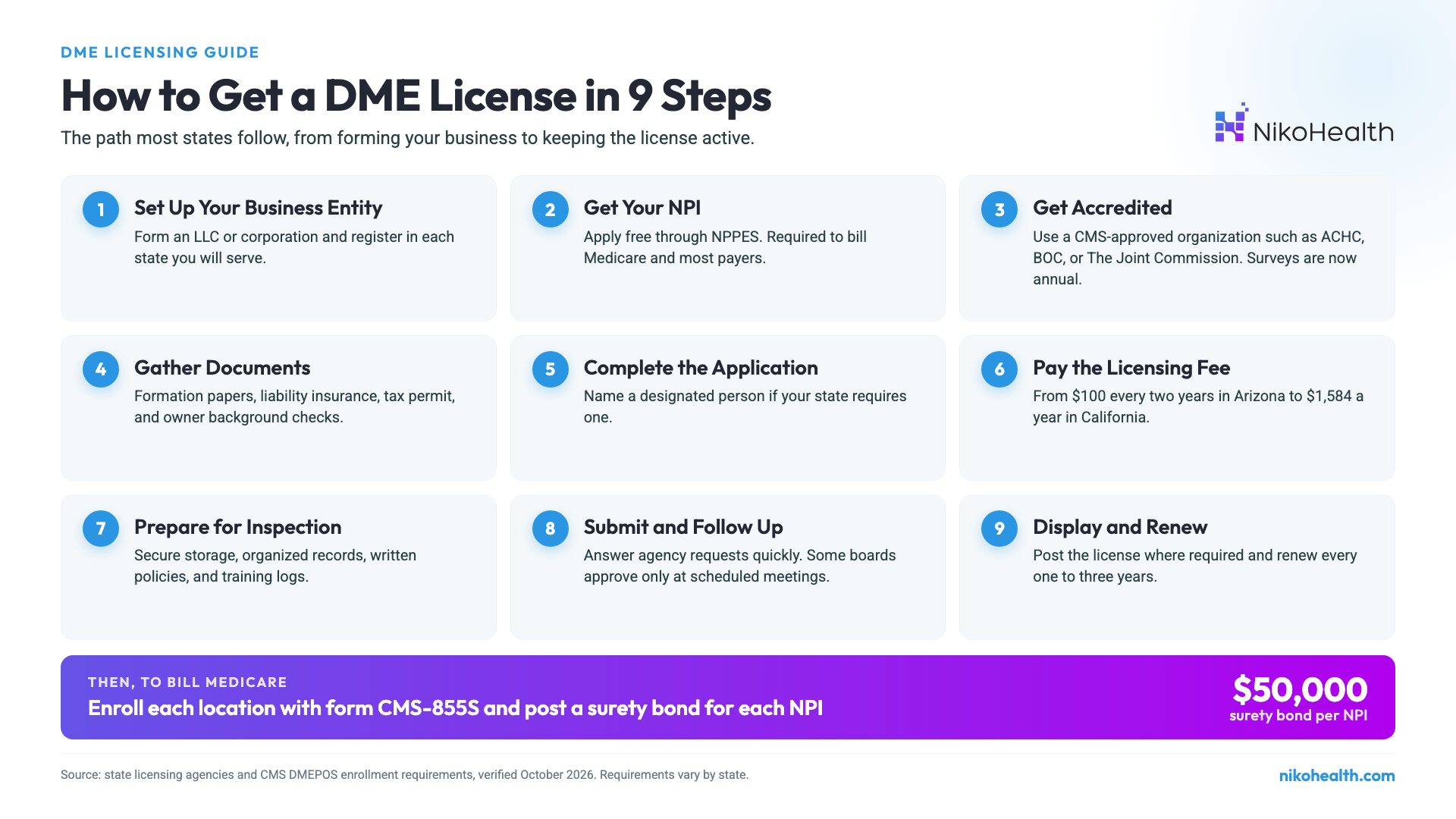
The exact process depends on the state, but most applications follow the same path.
1. Set Up Your Business Entity
Form your DME business as a legal entity, such as an LLC or corporation, and register it in your home state. You will need your formation documents for the license application. If you plan to serve patients in other states, you may need to register as a foreign business in those states first. North Dakota, for example, requires Secretary of State registration as part of its application.
2. Obtain Your National Provider Identifier (NPI)
An NPI is a unique 10-digit identifier for health care providers and suppliers. You need one to bill Medicare, Medicaid, and most commercial insurers. Apply online through the federal NPPES system. There is no fee.
3. Get Accredited by a CMS-Approved Organization
To bill Medicare, every DMEPOS location must be accredited by a CMS-approved accrediting organization, such as ACHC, BOC, The Joint Commission, or NABP. Accreditation is not a state license, but the two often overlap. Florida requires accreditation from out-of-state applicants, Kentucky accepts accreditation in place of a state inspection, and Nebraska ties its exemption to accreditation.
Since January 1, 2026, accredited suppliers must be resurveyed every year instead of every three years. Accreditation includes an on-site survey and can take several months, so start early. Our DMEPOS accreditation guide explains the process, costs, and what surveyors check.
4. Gather Required Documents
Most state applications ask for:
- formation documents and information on owners and officers
- proof of liability insurance (Illinois requires $1,000,000 in commercial general liability coverage, and Florida requires at least $250,000 per claim)
- a sales tax permit or resale certificate, where applicable
- proof of accreditation, if you have it
- a home-state license, if you are applying as an out-of-state supplier
Many states also require background checks or fingerprints for owners and key staff. Florida, for example, requires level 2 background screening.
5. Complete the Application
Download the application from your state’s licensing agency, or apply through its online portal. You will usually provide the business name, physical address, responsible persons, and the categories of equipment you supply.
Check whether the state requires a designated person. Nevada requires a full-time administrator. Georgia requires a designated representative. North Dakota requires suppliers to employ or contract with a licensed health care professional, such as a respiratory therapist, pharmacist, or nurse. California requires a licensed exemptee or pharmacist at facilities that sell prescription devices.
6. Pay the Licensing Fee
Every state charges a fee, and amounts vary widely. Arizona charges $100 every two years, North Dakota $200 a year, Kentucky $350, and Georgia $750 for an initial license. Florida charges a $304.50 license fee plus a $400 inspection fee. California’s in-state Home Medical Device Retailer license costs $1,584 a year. Keep proof of payment with your application records.
7. Prepare for an Inspection
Many states inspect your facility before or soon after issuing a license. Florida’s AHCA conducts a licensure inspection but can accept a full accreditation report instead. Nevada inspects in-state locations before they open. Kentucky inspects suppliers that are not accredited.
Inspectors typically check that you have a clean, secure storage area, organized patient and equipment records, written policies, and staff training records. Have these in order before you apply.
8. Submit Your Application and Respond to Follow-Up
Submit the application with all attachments and keep a confirmation. Agencies often follow up with questions or requests for missing documents. Respond quickly to keep your application moving. Some boards, such as Nevada’s, approve applications only at scheduled board meetings, which can add time.
9. Display and Maintain Your License
Once approved, display the license at your place of business if your state requires it. Kentucky, for example, requires the license to be posted. Track the license number and expiration date, report changes of address or ownership on time, and keep records for as long as state rules require.
DME License Cost and Fees
The cost of a DME license depends on the state and, in some cases, on your business size. Plan for these costs:
- State license fees. These range from $100 every two years in Arizona to $1,584 a year for an in-state license in California. Texas device distributor fees range from $495 to $1,731 per location, based on annual device sales.
- Inspection fees. Florida charges $400. Kentucky charges $350 for in-state inspections and actual cost for inspections outside the state.
- Medicare surety bond. CMS requires DMEPOS suppliers to post a $50,000 surety bond for each NPI they maintain.
- Accreditation. Accrediting organizations charge application and survey fees, and surveys are now annual. See our accreditation guide for typical ranges.
- Insurance. Required liability coverage, such as Illinois’s $1,000,000 minimum, is an ongoing cost.
- Renewal fees. Licenses renew every one to three years depending on the state, and renewal fees are often similar to the initial fee.
- Background checks. Fingerprinting and screening fees apply per person in states that require them.
How Long Does It Take to Get a DME License?
Timelines vary by state and by how complete your application is.
- State processing. Many states process a complete application in a few weeks to a few months.
- Inspections. If your state inspects before approval, scheduling the visit can add time.
- Board meetings. Where a board approves licenses at scheduled meetings, you may wait for the next one.
- Accreditation. The on-site survey and review often take several months, so start in parallel with your state application.
- Medicare enrollment. After you have your state license and accreditation, you enroll in Medicare using form CMS-855S or PECOS. DMEPOS applications are processed by the National Provider Enrollment contractors: Novitas Solutions for NPE East and Palmetto GBA for NPE West.
Taken together, getting fully licensed, accredited, and enrolled to bill Medicare commonly takes several months. Plan your launch or expansion date around the longest step.
Frequently Asked Questions
Which states require a DME license?
Many states require a license to supply durable medical equipment to their residents, including Arizona, California, Florida, Georgia, Illinois, Kentucky, Nevada, North Carolina, and North Dakota. Others, such as Nebraska, New York, Pennsylvania, and Texas, have no DME-specific license but may regulate device distribution, oxygen, or prescription devices. Check each state where you will serve patients.
How much does a DME license cost?
Fees vary by state. As of October 2026, Arizona charges $100 every two years, North Dakota $200 a year, Kentucky $350, Georgia $750 for an initial license, and Florida $304.50 plus a $400 inspection fee. California’s in-state Home Medical Device Retailer license costs $1,584 a year. Budget separately for accreditation, insurance, and the $50,000 Medicare surety bond.
How long does it take to get a DME license?
Many states process a complete application within a few weeks to a few months. Inspections, board meeting schedules, and missing documents can add time. Including accreditation and Medicare enrollment, getting ready to bill Medicare commonly takes several months.
What is the difference between a DME license and accreditation?
A DME license is issued by a state and allows you to supply equipment to patients in that state. Accreditation is issued by a CMS-approved accrediting organization and is required to bill Medicare. Most suppliers need both. Some states accept accreditation in place of a state inspection or require it from out-of-state applicants.
Do out-of-state DME suppliers need a license?
Often, yes. Arizona, California (for prescription devices), Florida, Illinois, Kentucky, Nevada, North Carolina, and North Dakota all license or register out-of-state suppliers that serve their residents. North Carolina also requires a physical location in the state or within 40 miles of its border.
Is there a federal DME license?
No. There is no federal DME license. To bill Medicare, a supplier must enroll through form CMS-855S, hold accreditation from a CMS-approved organization, post a $50,000 surety bond, and meet the Medicare DMEPOS supplier standards, including any state licensing requirements.
Conclusion and Next Steps
The key steps are simple to list and detailed to complete:
- check the rules in every state where you will serve patients
- keep your documents, insurance, and accreditation organized
- confirm fees and requirements with the issuing agency before you apply
With your license in hand, you can serve patients knowing you operate within the law and meet state safety standards.
Running a DME business takes more than a license. You also manage inventory, insurance billing, deliveries, and patient service, and the work multiplies as you add locations and states. NikoHealth is a cloud-based HME/DME platform that runs intake, orders, billing, inventory, and delivery in one system, with visibility across every location. It helps multi-location providers keep records organized for state inspections and accreditation surveys.
To see how it works, request a demo.


Related Articles