



Recurring supplies make up a large share of the work at most DME and HME companies. The patient count grows every month, and each one has their own schedule of masks, strips, catheters, pouches, and dressings. Ship too early and the claim is denied. Ship more than the policy allows without the right documentation and the extra units are denied too. If the refill request is missing at audit, Medicare can take back the whole claim.
This guide puts the replacement schedules for the five largest resupply categories on one page. It covers the HCPCS codes, the quantity limits, and the timing rules that apply to all of them.
Medicare Supply Replacement Schedules at a Glance
Category | Governing LCD / policy article | Example usual maximum | Most dispensed at one time |
CPAP / PAP supplies | Full face mask (A7030): 1 per 3 months | 3 months | |
Blood glucose testing and CGM | Test strips (A4253), insulin-treated: 300 per 3 months | 3 months (90 days for CGM) | |
Urological supplies | Intermittent catheters: 200 per month | 3 months | |
Ostomy supplies | Drainable pouch with barrier (A5061): 20 per month | 3 months at home, 1 month in a nursing facility | |
Surgical dressings (wound care) | Foam wound cover: up to 3 changes per week |
1 month |
Medicare Refill Rules: When You Can Contact the Patient and When You Can Ship
The timing rules sit in the “Refill Requirements” section of each LCD. The documentation rules sit in the DME MACs’ Standard Documentation Requirements article (A55426). Both changed on January 1, 2024, under the CY 2024 Home Health final rule (CMS-1780-F). The DME MACs restated them without changes in their January 2026 annual reminder.
1. Contact no sooner than 30 days before the supply runs out
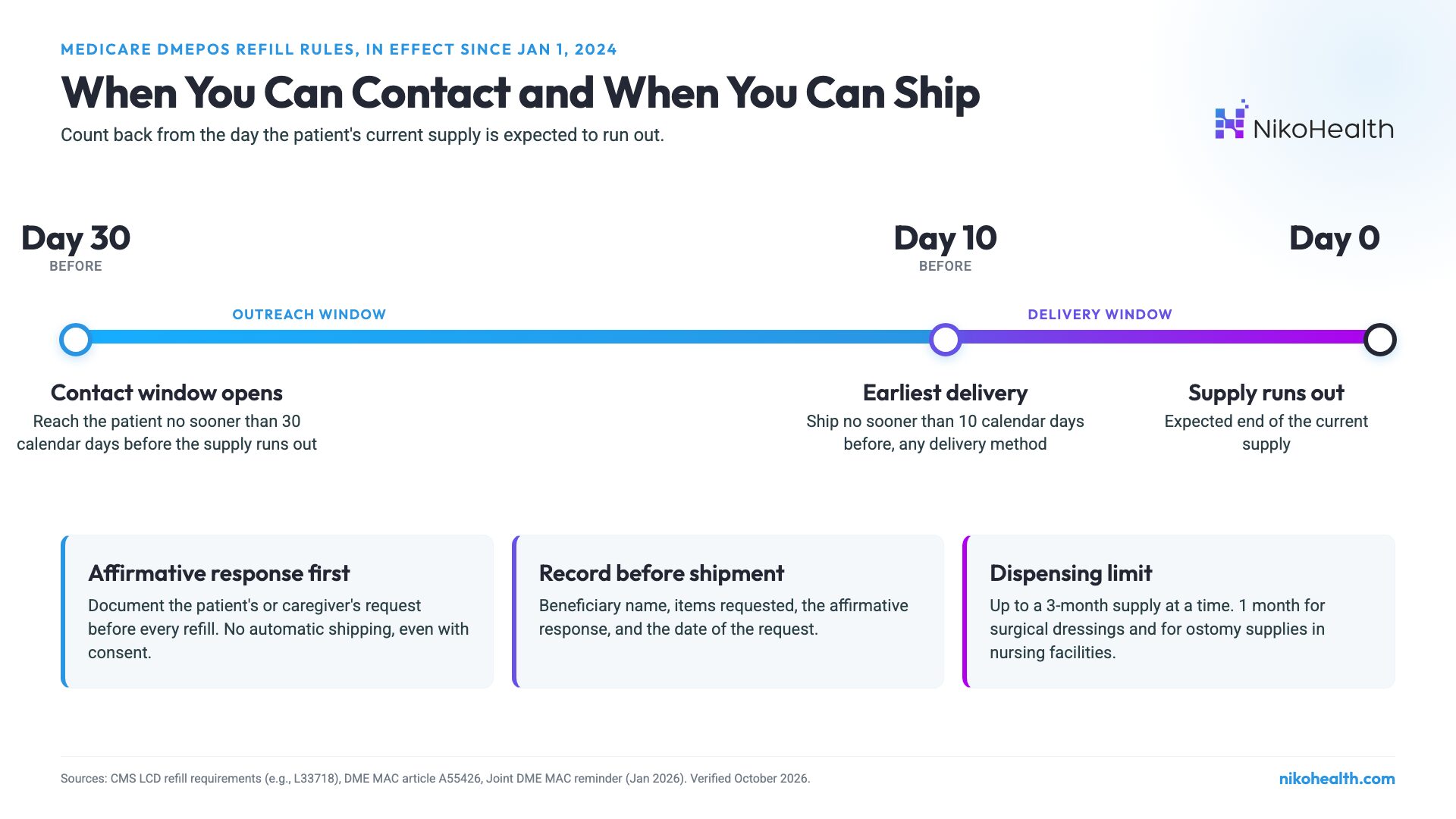
For items dispensed on a recurring basis, the supplier must contact the beneficiary no sooner than 30 calendar days before the expected end of the current supply. CGS has confirmed in its FAQ on the change that this rule replaced the old requirement to contact patients no sooner than 14 days before delivery. Many older training materials still show 14 days. That rule no longer applies.
2. Deliver no sooner than 10 days before the supply runs out
Delivery can happen no sooner than 10 calendar days before the expected end of the current supply, whatever the delivery method. For mail order, the supplier may use either the shipping date or the delivery date as the date of service, as long as it is consistent.
3. Get an affirmative response before every refill
The supplier must contact the beneficiary and document an affirmative response before it dispenses the refill. Refills cannot ship automatically on a set schedule, even if the patient has authorized it. Items delivered without a valid, documented refill request are denied as not reasonable and necessary.
4. Document the request before shipment
According to A55426, the refill record must include:
- The beneficiary’s name, or the authorized representative’s name if different
- A description of each item requested
- Documentation of an affirmative response showing a need for the refill
- The date of the refill request
The record must be created before the item ships. A statement written afterward by the supplier or the beneficiary is not accepted. Medicare does not prescribe a channel, so phone, text, email, and web confirmations all work if they capture every element. Quantity on hand and the functional condition of reusable items are no longer required fields. Many suppliers still ask about them because they help confirm actual use.
5. Stay within the dispensing limit
Regardless of utilization, a supplier cannot dispense more than a 3-month quantity at a time for most recurring supplies. Surgical dressings are limited to 1 month. Ostomy supplies are limited to 1 month for nursing facility residents. When a claim covers more than one month, A55426 asks suppliers to add a narrative such as “90-day supply.”
6. Keep the order, continued need, and continued use current
Every claim needs a standard written order (SWO) from the treating practitioner. A new order is needed when the quantity changes or an item is replaced. Continued need must be supported by a record from the past 12 months. Continued use is shown by the refill requests themselves. A55426 also requires suppliers to stop billing when the patient is no longer using the supplies.
CPAP Supply Replacement Schedule
PAP supplies follow the Positive Airway Pressure Devices for the Treatment of Obstructive Sleep Apnea LCD (L33718). The current revision took effect January 1, 2024. Accessories are covered when the patient meets the coverage criteria for the device.
HCPCS | Item | Medicare usual maximum |
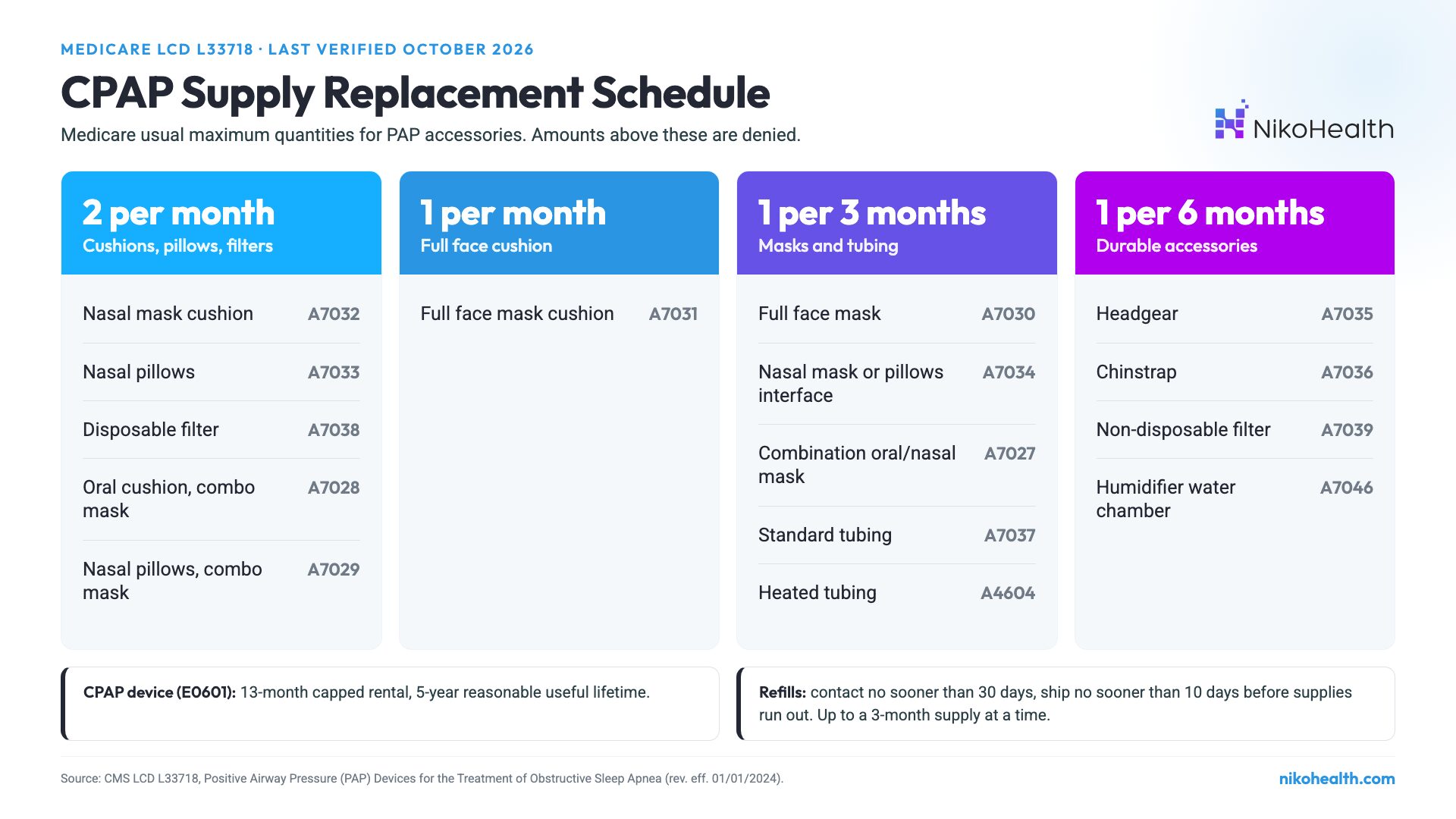
A7028 | Oral cushion for combination oral/nasal mask | 2 per month |
A7029 | Nasal pillows for combination oral/nasal mask | 2 per month |
A7032 | Replacement nasal mask cushion | 2 per month |
A7033 | Replacement nasal pillows | 2 per month |
A7038 | Disposable filter | 2 per month |
A7031 | Replacement full face mask cushion | 1 per month |
A7027 | Combination oral/nasal mask | 1 per 3 months |
A7030 | Full face mask | 1 per 3 months |
A7034 | Nasal mask or nasal pillows interface | 1 per 3 months |
A7037 | Standard tubing | 1 per 3 months |
A4604 | Heated tubing | 1 per 3 months |
A7035 | Headgear | 1 per 6 months |
A7036 | Chinstrap | 1 per 6 months |
A7039 | Non-disposable filter | 1 per 6 months |
A7046 | Humidifier water chamber | 1 per 6 months |
The PAP rules work differently from the other categories in three ways.
Quantities above the maximum are denied. L33718 says supplies above the usual maximum are denied as not reasonable and necessary. Unlike the urological, ostomy, and glucose LCDs, it has no exception for extra documentation. A7044 (oral interface) and A7045 (exhalation port) have no usual maximum in the current LCD.
Adherence decides continued coverage. Coverage after the first 3 months requires use of 4 or more hours per night on 70% of nights in a consecutive 30-day period. That period must fall within the first 3 months. The treating practitioner must also do a clinical re-evaluation between day 31 and day 91 and review the objective adherence data. From the fourth month’s claim, the supplier adds the KX modifier only when both the initial and continued coverage criteria are met.
The device has a 5-year reasonable useful lifetime. The CPAP device (E0601) is a capped rental. Medicare pays rent for up to 13 continuous months, and then ownership passes to the patient under 42 CFR 414.229. A device replaced within 5 years because of loss, theft, or irreparable damage needs no new sleep test or trial. A device replaced after 5 years needs an in-person evaluation that documents continued use and benefit. The heated (E0562) and non-heated (E0561) humidifiers have no quantity limit in the LCD.
Large sleep programs feel the PAP rules first because the per-patient schedule mixes monthly, quarterly, and semiannual items. GEM Sleep and iSleep Home Sleep Solutions are two sleep providers that run this cycle at volume.
Diabetic Testing Supplies and CGM Replacement Schedule
Blood glucose monitors, testing supplies, and CGMs fall under the Glucose Monitors LCD (L33822) and policy article A52464. The limits depend on whether the patient is treated with insulin.
Blood glucose testing supplies
HCPCS | Item | Insulin-treated (KX modifier) | Not insulin-treated (KS modifier) |
A4253 | Test strips, per 50 | Up to 300 strips per 3 months | Up to 100 strips per 3 months |
A4259 | Lancets, per 100 | Up to 300 lancets per 3 months | Up to 100 lancets per 3 months |
A4258 | Lancing device | 1 per 6 months | 1 per 6 months |
A4256 | Control solution | Covered with a covered monitor, no set number | Covered with a covered monitor, no set number |
Higher quantities can be covered when three conditions are documented. The patient must meet the basic monitor criteria. They must have had an in-person or Medicare-approved telehealth visit within 6 months before the order that evaluated diabetes control and the need for more testing. The practitioner must also verify adherence to the higher testing regimen every 6 months. The record should show the quantity ordered and the patient’s actual testing frequency.
Continuous glucose monitors
HCPCS | Item | Billing and frequency rule |
E2103 | Non-adjunctive CGM receiver | Billed with the A4239 supply allowance |
E2102 | Adjunctive CGM receiver | Billed with the A4238 supply allowance, KF modifier required |
A4239 | Supply allowance, non-adjunctive CGM | 1 unit = 30 days. Up to 3 units (90 days) billed at once |
A4238 | Supply allowance, adjunctive CGM | 1 unit = 30 days. Up to 3 units (90 days) billed at once |
The A4239 allowance includes sensors and transmitters. It also includes a backup blood glucose meter with its strips, lancets, lancing device, control solution, and batteries, so those are not billed separately. Supplies for the full 30 days after each date of service must already be delivered. A CGM that works only with a smartphone, with no separate receiver, is non-covered.
CGM coverage requires diabetes, a prescription that follows the device’s FDA indications, and either insulin treatment or a documented history of problematic hypoglycemia. The patient also needs a visit within 6 months before the order. For continued coverage, the practitioner must see the patient in person or by Medicare-approved telehealth every 6 months and document adherence. A52464 applies that rule to patient-owned CGMs that Medicare paid for, too.
One change is coming. Under the CY 2026 DMEPOS final rule, Class II CGMs and insulin pumps move to monthly rental payments, with supplies included, once Round 2028 of competitive bidding starts. That will be no later than January 1, 2028. Our DME compliance updates page tracks the Round 2028 dates.
Urological Supplies Replacement Schedule
Catheters and related supplies follow the Urological Supplies LCD (L33803), most recently revised April 1, 2026. This category gets close audit attention. In its September 2026 DMEPOS fraud hot spot report, CMS listed urological supplies as the DMEPOS item with the highest projected improper payments in FY 2025, about $885 million. That is a 74.1% improper payment rate, driven mainly by missing or insufficient documentation.
HCPCS | Item | Medicare usual maximum |
A4295, A4296 | Hydrophilic intermittent catheter, straight or coude tip (new January 1, 2026) | 200 per month |
A4351, A4352 | Intermittent catheter, uncoated or non-hydrophilic coating, straight or coude tip | 200 per month |
A4332 | Sterile lubricant, single packet | 200 per month (one per A4351 or A4352 use) |
A4297, A4353 | Sterile intermittent catheter kit, hydrophilic or other | 200 per month combined |
A4338, A4340, A4344, A4346 | Indwelling (Foley) catheter | 1 per month for routine changes |
A4314, A4315, A4316 | Insertion tray with catheter | 1 per month |
A4354 | Insertion tray with drainage bag, no catheter | 1 per month |
A4349 | Male external catheter | Generally no more than 35 per month |
A4357 | Bedside drainage bag | 2 per month |
A4358 | Leg bag, vinyl | 2 per month |
A5112 | Leg bag, latex | 1 per month (A4358 or A5112, not both) |
A5102 | Bedside drainage bottle | 1 per 3 months |
A4327 | Female external urinary collection device, meatal cup | 1 per week |
A4328 | Female external urinary collection device, pouch | 1 per day |
A4356 | External urethral clamp | 1 per 3 months |
The 2026 hydrophilic code change. On January 1, 2026, hydrophilic intermittent catheters moved from A4351 and A4352 to the new codes A4295 (straight tip) and A4296 (coude tip), and hydrophilic kits moved to A4297. CGS announced the change in December 2025. Suppliers should make sure orders and resupply items on file use the new codes.
One product per catheterization. For each intermittent catheterization, Medicare covers one of three options. It can be an uncoated catheter with one packet of lubricant, a hydrophilic catheter, or a sterile kit when the kit criteria are met. A kit is covered when the patient lives in a nursing facility, is immunosuppressed (a documented spinal cord injury now qualifies), has radiologically documented vesico-ureteral reflux, or had 2 distinct UTIs in the previous 12 months while using sterile technique.
When more is allowed. Indwelling catheters can be changed more than once a month when the record documents accidental removal, malfunction, obstruction, or recurrent infection. Coude tips need documentation of why a straight tip cannot be used. Leg bags are denied for bedridden patients.
Ostomy Supplies Replacement Schedule
Ostomy supplies follow the Ostomy Supplies LCD (L33828) and policy article A52487. They are paid under the prosthetic device benefit, so once the initial need is established, continued need is assumed. The LCD uses one table for all ostomy types. In practice, closed pouches are mostly used for colostomies, drainable pouches for ileostomies, and urinary pouches for urostomies.
Item | HCPCS | Medicare usual maximum |
Closed pouch, with or without barrier | A5051, A5052, A5054, A4416 to A4419, A4423 | 60 per month |
Drainable pouch | A5061, A5062, A5063, A4424 to A4427 | 20 per month |
Drainable pouch with extended-wear barrier | A5056, A5057 | 40 per month |
Urinary pouch | A5071, A5072, A5073, A4429, A4431 to A4434 | 20 per month |
Skin barrier with flange (wafer) | A4414, A4415 | 20 per month |
Solid skin barrier | A4362, A5121, A5122 | 20 per month |
Ostomy belt | A4367 | 1 per month |
Ostomy paste, per ounce | A4405, A4406 | 4 per month |
Liquid skin barrier, per ounce | A4369 | 2 per month |
Skin barrier wipes or swabs | A5120 | 150 per 6 months |
Barrier powder, per ounce | A4371 | 10 per 6 months |
Adhesive remover, per ounce | A4455 | 16 per 6 months |
Faceplate | A4361 | 3 per 6 months |
Irrigation bag and cone or catheter | A4398, A4399 | 2 per 6 months each |
Irrigation sleeve | A4436, A4437 | 1 per month |
Bedside drainage bag (urostomy) | A4357 | 2 per month |
Actual use depends on how often the patient changes the barrier and pouch, so the LCD allows quantities above the table. The reason must be clearly documented in the medical record and available on request. Otherwise the extra units are denied. Liquid barrier (A4369) and barrier wipes (A5120) cannot both be billed. Ostomy supplies are not separately payable during a covered home health episode.
Wound Care Supplies (Surgical Dressings) Replacement Schedule
Wound care supplies follow the Surgical Dressings LCD (L33831) and policy article A54563. Unlike the other categories, dressing limits are change frequencies per wound, not monthly totals.
Dressings are covered for a wound caused by or treated by a surgical procedure, or a wound that has been debrided. A Stage 1 pressure ulcer, a first-degree burn, or a skin tear that needs no closure or debridement does not qualify. The treating practitioner, or their designee, must update the wound evaluation at least monthly. It should be weekly for nursing facility patients and for heavily draining or infected wounds. A new order is needed every 3 months for each dressing, and whenever a dressing is added or its quantity goes up.
Dressing type | HCPCS | Maximum change frequency |
Alginate or fiber gelling | A6196 to A6199 | Up to once per day |
Collagen | A6010, A6011, A6021 to A6024 | Can stay in place up to 7 days |
Composite | A6203 to A6205 | Up to 3 times per week |
Contact layer | A6206 to A6208 | Up to once per week |
Foam, wound cover | A6209 to A6214 | Up to 3 times per week |
Foam, wound filler | A6215 | Up to once per day |
Gauze, non-impregnated, without border | A6216, A6217, A6218, A6402 to A6404 | Up to 3 times per day |
Gauze, non-impregnated, with border | A6219 to A6221 | Up to once per day |
Hydrocolloid | A6234 to A6241 | Up to 3 times per week |
Hydrogel, cover without border or filler | A6242 to A6244, A6248 | Up to once per day |
Hydrogel, cover with border | A6245 to A6247 | Up to 3 times per week |
Specialty absorptive | A6251 to A6256 | Once per day without border, every other day with border |
Transparent film | A6257 to A6259 | Up to 3 times per week |
Gradient compression wrap | A6545 | 1 per 6 months per leg |
A few combination rules affect the order. The dressing in contact with the wound sets the change frequency. Products with different change intervals cannot be combined. Only one type of filler and one type of cover can be used per wound, with limited exceptions. Gauze impregnated with water or saline (A6228 to A6230) is denied as not reasonable and necessary. Hydrogel filler (A6248) is limited to 3 fluid ounces per wound per 30 days.
The refill timing is the same as in other categories, with contact no sooner than 30 days and delivery no sooner than 10 days before the supply runs out. But no more than a 1-month supply of dressings can be provided at a time, unless the record supports a larger quantity for that patient. Gradient compression garments for lymphedema now follow a separate benefit. Patients can get 3 daytime garments per affected body part every 6 months and 2 nighttime garments every 2 years.
Common Resupply Mistakes That Lead to Denials
Most resupply denials come from timing and documentation, not coverage. These are the errors that show up again and again:
- Using the old 14-day rule. Scripts and system settings built before 2024 may still be set to 14 days. That is not a compliance violation, but it gives patients less time to respond.
- Shipping too early. A delivery more than 10 days before the current supply runs out is outside the rule, even if the patient asked for it.
- Treating standing consent as a refill request. An auto-ship agreement does not replace the affirmative response for each refill.
- Weak refill records. A note that says “patient confirmed” without the date, the items, and who responded will not hold up in an audit.
- Exceeding the maximum without support. For glucose, urological, and ostomy supplies, extra units need a documented reason in the medical record. For PAP supplies, they are denied either way.
- Stale orders and codes. A 2025 catheter order may still say A4351 for what is now an A4295 hydrophilic catheter. Dressing orders expire after 3 months.
- Missing continued-need visits. CGM patients and patients on high-volume glucose testing need a practitioner visit every 6 months.
How to Manage Replacement Schedules at Scale
A small supplier can track replacement dates in a spreadsheet. Once a company serves thousands of patients across several branches and payers, that stops working. Each patient’s items have different frequencies, commercial and Medicaid plans add their own rules, and every refill needs an outreach record created before shipment.
Whatever system you use, it should do four things. It should calculate each patient’s next eligible date from the last date of service and the payer’s frequency rule. It should open outreach only inside the 30-day window. It should block shipment before the 10-day window. And it should store the patient’s confirmation, with the date and the items, alongside the order.
Suppliers handle this in different ways. Some use the resupply module in their billing platform, some use standalone outreach tools, and some still rely on call center staff. NikoHealth’s resupply module sets rules by product and payer, generates orders when patients become eligible, and runs text, email, and Voice AI outreach in one campaign. Patients confirm through a secure link or a call, and the confirmation is saved with the order. Quality DME, which runs automated resupply campaigns for more than 22,000 patients, saw a 400%+ increase in patient response rates, as described in how DMEs are automating patient outreach.
No software decides coverage for you. The LCD, the patient’s medical record, and the payer contract still set the rules. Software helps apply them the same way every time.
Want to see how multi-location DME providers run resupply on NikoHealth? Request a demo.
Medicare Supply Replacement Schedule FAQ
How often does Medicare pay for CPAP supplies?
Under LCD L33718, Medicare covers nasal cushions, nasal pillows, and disposable filters 2 per month, a full face mask cushion 1 per month, masks and tubing 1 per 3 months, and headgear, chinstraps, non-disposable filters, and water chambers 1 per 6 months. Quantities above these amounts are denied.
How many days before the refill date can a DME supplier contact the patient?
No sooner than 30 calendar days before the expected end of the current supply. This rule took effect January 1, 2024, and replaced the earlier rule of contacting patients no sooner than 14 days before delivery.
How early can a DME supplier ship a Medicare refill?
No sooner than 10 calendar days before the expected end of the current supply, whatever the delivery method. The supplier must also have a documented affirmative response from the patient or caregiver before shipping.
Can Medicare supplies be shipped automatically every month?
No. Medicare does not allow refills to ship automatically on a set schedule, even if the patient agreed to it. The supplier must contact the patient and document a request for each refill before dispensing.
How many test strips does Medicare cover?
Up to 300 test strips and 300 lancets every 3 months for insulin-treated patients, and up to 100 of each every 3 months for patients not treated with insulin. Higher quantities need a recent practitioner visit and documented testing frequency.
How often does Medicare pay for CGM supplies?
CGM supplies are billed as a monthly supply allowance (A4239 or A4238), where 1 unit covers 30 days. Suppliers can bill up to 3 units, a 90-day supply, at once. The patient needs a practitioner visit every 6 months to keep coverage.
How many catheters does Medicare cover per month?
Up to 200 intermittent catheters per month, which covers one catheter per catheterization. Indwelling Foley catheters are covered 1 per month for routine changes, and male external catheters are generally limited to 35 per month.
How many ostomy pouches does Medicare cover per month?
Up to 60 closed pouches or 20 drainable or urinary pouches per month, depending on the type. Skin barriers with flanges are covered up to 20 per month. More can be covered when the medical record documents the need.
How much wound care supply can be dispensed at once?
No more than a 1-month supply of surgical dressings at a time, unless the record supports more. Each dressing type has its own maximum change frequency, from up to 3 times per day for plain gauze to once per week for contact layers.
What is the maximum supply Medicare allows per shipment?
For most recurring supplies, no more than a 3-month quantity at a time. Surgical dressings, and ostomy supplies for nursing facility residents, are limited to 1 month.


Related Articles