



What Is DME Delivery Route Optimization?
DME delivery route optimization is software that plans, sequences, and continuously adjusts delivery routes for a fleet based on live traffic, delivery windows, vehicle capacity, and driver location. Instead of a dispatcher building a fixed route the night before, the system recalculates automatically as conditions change: a delayed stop, a same-day add-on, a driver running ahead of or behind schedule.
This matters more in HME/DME delivery than in general logistics: deliveries carry appointment-specific timing — a discharge, an oxygen setup, a CPAP fitting — plus e-signature requirements and billing dependencies that a missed stop can push back by days. DME route planning built around fixed, manually sequenced routes has no built-in way to absorb any of that without a dispatcher rebuilding the day by hand.
How DME delivery route optimization differs from static route planning
Static route planning treats a route as a fixed plan: stops in a set order, built once, followed regardless of what happens after the vehicle leaves the warehouse. DME delivery route optimization treats a route as a live model that ingests new information throughout the day — an emergency oxygen order, a patient who isn’t home, a traffic incident — and re-sequences the remaining stops around it, much like DME providers already automate payer rules and eligibility checks instead of relying on fixed instructions.
Where DME Delivery Route Optimization Fits in the Order-to-Cash Workflow
If your company still treats delivery as the last step of fulfillment and billing as a separate back-office process, DME delivery route optimization changes where that line sits. It fits inside the order-to-cash workflow, between order confirmation and the moment a claim or invoice is submitted, which is why HME delivery optimization is increasingly discussed alongside billing and inventory rather than as a separate logistics function. For a multi-location provider, that means the same platform driving your routes can also be what starts your billing cycle.
From dispatch to delivery: how routes get built and updated in real time
Once an order is confirmed on your end, DME delivery management software assigns it to a route based on vehicle capacity, delivery zone, driver availability, and the delivery window given to the patient or facility. As the day progresses, your dispatchers get real-time visibility into where each driver stands relative to remaining stops, and the system reroutes automatically when a new order comes in, a stop runs long, or traffic disrupts the planned path.
The handoff from proof of delivery to the billing trigger
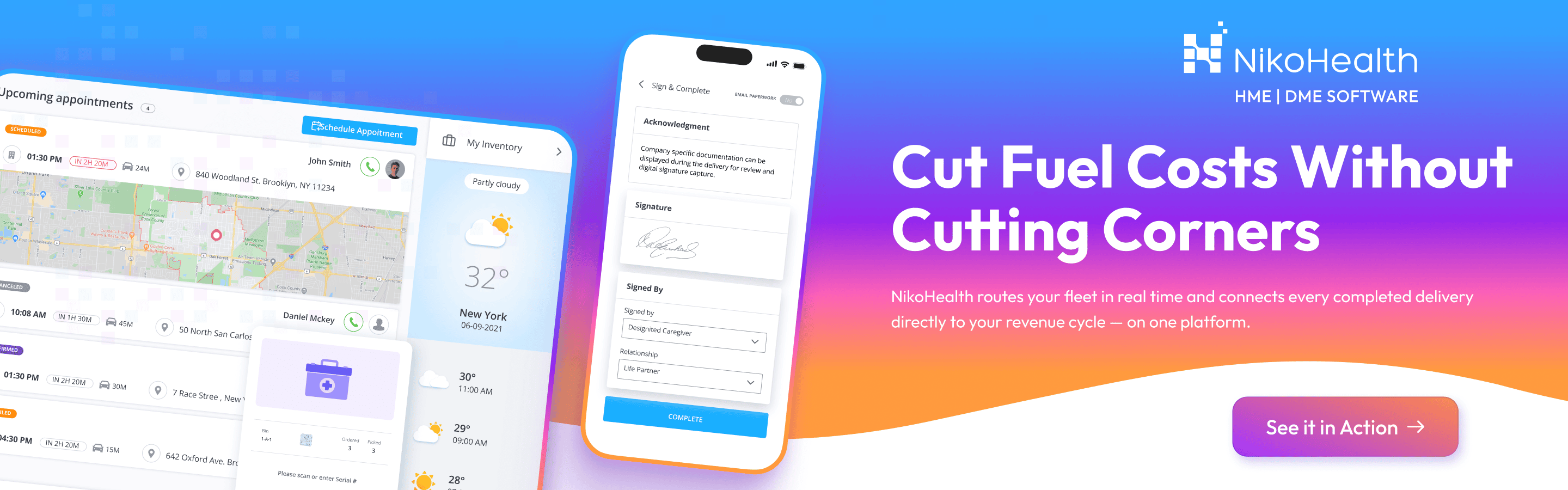
The point where DME delivery route optimization connects most directly to revenue cycle management is proof of delivery. When a driver captures an e-signature through NikoHealth’s delivery management platform, that confirmation can trigger billing automatically instead of waiting for paperwork to route back to the office.
The Fuel Cost Impact of DME Route Planning
Fuel is one of the largest controllable line items in operating a DME delivery fleet, and it is directly shaped by how routes are built. Fuel accounts for roughly 21% of the average per-mile cost of running a truck, according to ATRI’s 2025 operational cost benchmark, and every extra mile driven because a route wasn’t sequenced efficiently adds directly to that figure.
DME route planning that adjusts in real time reduces this exposure in two ways: it minimizes miles driven by sequencing stops around geography rather than a static list, and it reduces the aggressive driving — hard braking, quick acceleration, idling while replanning — that comes with falling behind schedule, which the Department of Energy notes can lower fuel economy by up to 40% in stop-and-go conditions. DME delivery route optimization removes much of that incentive by keeping the schedule realistic in real time.
Factor | Static route planning | DME delivery route optimization |
Route built | Once, before the day starts | Continuously, throughout the day |
Response to a delay or a new order | Requires a manual dispatcher rebuild | Automatic re-sequencing |
Missed-window risk | Compounds across zones and locations | Flagged in real time, before it becomes a miss |
Billing trigger | Manual entry once paperwork returns | Can fire automatically at proof of delivery |
Reducing Missed Delivery Windows Without Adding Drivers
A missed delivery window in DME rarely stays contained to one stop: a late oxygen setup or a rescheduled CPAP delivery pushes into the next window, and across a multi-location operation running high-volume DME order workflows, that delay compounds by day’s end. HME delivery optimization addresses this at the source, re-sequencing the remaining route the moment a delay is detected instead of asking the driver to make up time on every stop that follows.
Real-time tracking and dispatcher visibility when plans change mid-route
Real-time driver tracking gives dispatchers the same picture the routing engine has: where every vehicle is, how far ahead or behind schedule it’s running, and which stops are at risk. When a same-day or emergency order comes in, dispatchers can see which driver is realistically positioned to take it — the visibility that lets DME delivery route optimization absorb changes without adding staff or vehicles.
Closing the Billing Lag: From Proof of Delivery to Invoice
Every day a proof-of-delivery record sits in a driver’s tablet before it reaches billing is a day added to days’ sales outstanding. DME delivery route optimization paired with an automatic billing trigger closes that gap by treating delivery confirmation as the start of the billing event rather than a separate step handled later.
The effect shows up in practice, not just in theory: Precision Medical Products consolidated onto a single platform and brought its DSO down from 120 days to 75 days. For capped rental equipment, where billing recurs on a fixed cycle, closing the lag between delivery and invoice compounds across every rental month rather than producing a one-time gain.
Why Delivery Timing Still Shapes the Patient Experience in DME
DME delivery route optimization is not a replacement for drivers or dispatch staff — it gives the people already doing that work better information. A route built around real-time conditions means a patient waiting on a hospital bed after discharge, or an oxygen setup ahead of a weekend, gets a more reliable window rather than a rushed visit squeezed around a fixed schedule.
Delivery timing carries more weight in DME than in general retail logistics, since the equipment is often tied to a clinical need: a late wheelchair delays a discharge, and a missed CPAP delivery delays therapy. HME delivery optimization supports that reliability by giving dispatchers the tools to protect delivery windows as conditions change, rather than leaving drivers to absorb every disruption alone.
How to Prepare for DME Delivery Route Optimization
Moving from static routing to DME delivery route optimization is a data and workflow question, not a fleet overhaul — providers already comfortable with DME route planning and optimizing DME business workflows will recognize most of the underlying logic. A few steps make the transition smoother:
- Map current delivery zones and volume. Software can’t optimize routes without an accurate picture of where deliveries happen and how many stops each zone handles daily.
- Confirm how proof of delivery reaches billing today. Map that path — scanned, mailed, or manually keyed in — since it’s what an automatic billing trigger replaces.
- Check multi-location and NPI structure. Providers operating across several locations need routing and billing tied to the correct National Provider Identifier per site.
- Plan a phased rollout by zone. Introducing DME delivery route optimization to one zone first gives dispatchers and drivers time to adjust before it runs across the full fleet.
What to Look for in DME Delivery Management Software
Not every delivery or fleet tool built for general logistics accounts for what HME/DME operations need, especially providers scaling toward enterprise-level order volume. The table below outlines what to check before selecting DME delivery management software, and why it matters specifically for a DME provider.
Criterion | What to check | Why it matters for DME |
Proof-of-delivery capture | E-signature and digital documentation at the doorstep | Required for billing and audit trails, not just delivery confirmation |
Billing-trigger integration | Delivery confirmation connects directly to billing | Removes the manual handoff that stretches DSO |
Multi-location support | Routing and reporting separated by site and NPI | Each location bills and reports independently |
Real-time re-routing | Routes adjust automatically as conditions change | Static routes can’t absorb same-day orders or delays |
HIPAA-compliant mobile access | Field app secures patient data captured during delivery | DME deliveries routinely involve protected health information |
If you’re weighing your options against this list, it’s worth checking whether your current setup handles all five, or whether delivery, billing, and inventory still live in separate systems you have to reconcile by hand. NikoHealth brings DME delivery route optimization, proof-of-delivery capture, and an automatic billing trigger onto the same platform that already runs your billing and inventory, so a completed delivery doesn’t wait on a separate system to become revenue. Request a demo to see how it fits your specific delivery operation.
FAQ
How does DME delivery route optimization handle last-minute or emergency orders?
The system re-sequences the remaining stops on a route automatically when a new order comes in, based on which driver is realistically positioned to take it, rather than requiring a dispatcher to manually rebuild the day’s plan.
Does DME delivery management software integrate with existing billing and inventory systems?
When delivery, billing, and inventory sit on the same platform, proof of delivery can trigger billing directly and update inventory in the same step, rather than requiring separate systems to be reconciled afterward.
How quickly can a DME provider expect fuel savings from HME delivery optimization?
Savings typically appear within the first few weeks, coming from fewer total miles driven through better stop sequencing and less aggressive driving once schedules stop requiring drivers to make up lost time.
Does DME delivery route optimization replace dispatchers or delivery drivers?
No. It gives dispatchers real-time visibility and automated re-sequencing to work with, but decisions about exceptions, patient communication, and field judgment still rest with dispatch and delivery staff.
How does an automatic billing trigger at delivery affect DSO for capped rental equipment?
Because capped rental billing recurs on a fixed cycle, closing the lag between proof of delivery and invoice generation compounds across every billing period rather than producing a single one-time DSO improvement.


Related Articles