



Billing durable medical equipment (DME) to Medicare is one of the most technical and compliance-sensitive parts of the healthcare revenue cycle. In 2027, suppliers face annual accreditation, a growing prior authorization list, and the run-up to the first competitive bidding round since 2023. Knowing the rules is the difference between clean claims and recoupments.
This guide covers the Medicare DME billing requirements for 2027, from enrollment and documentation to coding, claim submission, competitive bidding, audits, and how DME billing software supports compliance at high claim volumes.
Enrollment and Supplier Requirements
Before a supplier can bill Medicare for DME, it must complete several enrollment and compliance steps. Medicare enforces supplier oversight closely to make sure only qualified suppliers are paid. Getting enrollment right protects patients and shields suppliers from denials, audits, and penalties.
To participate in Medicare DME billing, a supplier must:
- Enroll in Medicare and receive a supplier number. Each enrolled location receives a PTAN (Provider Transaction Access Number) and bills under its own NPI. Enrollment involves a detailed application, a site visit, and verification of the business.
- Hold accreditation from a CMS-approved accrediting organization. Accreditation confirms the supplier meets federal quality, safety, and operational standards, and it is required to bill for DMEPOS items.
- Maintain a surety bond of at least $50,000 for each enrolled location. The bond protects Medicare if the supplier owes money for improper payments.
- Meet the Medicare DMEPOS supplier standards. These cover a physical location open to the public, trained staff, inventory and delivery processes, complaint handling, and documentation practices that stand up to audits.
Accreditation Is Now Annual
The CY 2026 Home Health and DMEPOS final rule requires suppliers to be resurveyed and reaccredited every year instead of every three years, effective January 1, 2026. A supplier’s annual cycle starts when its current three-year accreditation expires, so many suppliers will go through their first annual survey in 2027. Surveys can be unannounced and can include patient file reviews and inventory checks. Our DMEPOS accreditation guide covers what surveyors look for.
Enrollment Oversight Is Tighter
The same rule expanded the grounds on which CMS can revoke a supplier’s enrollment retroactively, which lets Medicare recover payments made during a period of noncompliance. CMS proposed further enrollment safeguards in its CY 2027 rule. Keeping enrollment records, bonds, and location details current is now as important as clean claims. Our guide to avoiding Medicare PTAN deactivations explains the most common enrollment pitfalls.
Medical Necessity and Written Orders
Medical necessity is the foundation of every Medicare DME claim. Medicare pays only when the record clearly shows the item was ordered to diagnose or treat a specific condition and meets the coverage criteria in the applicable Local Coverage Determination (LCD). Strong documentation leads to timely payment and protects suppliers in audits.
Standard Written Orders (SWOs)
Medicare requires a Standard Written Order (SWO) for every DMEPOS item billed. Medicare eliminated Certificates of Medical Necessity (CMNs) and DME Information Forms (DIFs) for claims with dates of service on or after January 1, 2023, and rejects claims that include them. The SWO and the patient’s medical record now carry that information.
An SWO must include the following elements:
SWO element | What to include | Notes |
Beneficiary name or Medicare Beneficiary Identifier (MBI) | The patient’s full name or MBI | Must match Medicare records |
Order date | The date the order was written | For items on the Required Face-to-Face Encounter and Written Order Prior to Delivery List, the supplier must have the order before delivery |
Item description | A general description of the item, using a HCPCS code, a HCPCS code narrative, or a brand name and model number | Use current codes. Incorrect coding is a top reason for denials |
Quantity | The quantity to be dispensed, if applicable | Important for supplies billed on a recurring basis |
Treating practitioner name or NPI | The full name or National Provider Identifier of the ordering practitioner | The practitioner must be enrolled in Medicare or validly opted out |
Treating practitioner signature | A handwritten or valid electronic signature | Stamped signatures are not accepted |
Face-to-Face Encounters and Supporting Records
For items on CMS’s Required Face-to-Face Encounter and Written Order Prior to Delivery List, the treating practitioner must see the patient within the six months before the order, and the supplier must have the written order before delivering the item. CMS proposed in its CY 2027 rule that a new face-to-face encounter would not be needed when an item is replaced with one under the same HCPCS code. A new order would still be required.
Every order should be backed by a medical record that shows:
- The diagnosis or condition the item treats
- Functional limitations or impairments
- Treatment goals for the equipment
- Notes from the face-to-face evaluation, where required
When the order and the record agree, suppliers meet Medicare’s requirements and lower their audit risk.
Prior Authorization Requirements
For items on the Medicare Required Prior Authorization List, prior authorization is a condition of payment. A claim submitted without an approved request is denied. The list includes certain power mobility devices, pressure-reducing support surfaces, orthoses, and pneumatic compression devices.
CMS expanded the list twice in 2026. On April 13, 2026, it added seven codes, including pneumatic compression devices E0651 and E0652. On October 28, 2026, it added eight more: thoracic-lumbar-sacral orthoses L0456, L0457, and L0486, knee orthosis L1833, air-fluidized bed E0194, and ultralightweight manual wheelchair K0005 nationwide, plus elbow and wrist-hand orthoses L3761 and L3916 in a phased rollout. See how to get DME prior authorizations approved faster.
Coding and Modifiers: What Billers Need to Know
Accurate coding is the next requirement for clean Medicare DME claims.
- HCPCS Level II codes identify the specific DME item on the claim. CMS updates them quarterly.
- Modifiers show how the item was furnished and whether policy criteria are met. Common examples are NU (new purchase), RR (rental), UE (used purchase), KX (LCD requirements met), and KH, KI, and KJ for capped rental months.
- ICD-10-CM diagnosis codes must support medical necessity under the applicable LCD.
Using deleted or outdated codes is one of the most common reasons Medicare denies DME claims. Build quarterly HCPCS updates into your billing calendar.
Payment Rules: Fee Schedule, Rentals, and Purchases
Medicare pays most DME at 80% of the lower of the supplier’s charge or the DMEPOS fee schedule amount, and the beneficiary owes the remaining 20% after the Part B deductible. CMS updates the fee schedule each January and adjusts it quarterly. For CY 2026, most items not under competitive bidding received a 2.0% update, based on a 2.7% CPI-U increase minus a 0.7% productivity adjustment. CMS publishes the CY 2027 update in December. Our Medicare DME fee schedule guide explains how to find the right rate.
Payment category | How Medicare pays | Examples |
Capped rental | Monthly rental for up to 13 continuous months, then the beneficiary owns the item | Hospital beds, standard wheelchairs, CPAP devices |
Oxygen equipment | Monthly rental for 36 months. The supplier then keeps furnishing the equipment for the rest of its five-year reasonable useful lifetime without rental payments | Oxygen concentrators, portable oxygen |
Frequent and substantial servicing | Monthly rental for as long as the item is medically necessary | Ventilators; CGMs and insulin pumps once furnished under competitive bidding |
Inexpensive or routinely purchased | Purchase or rental, whichever the beneficiary chooses, within payment limits | Canes, walkers, some accessories |
Supplies | Paid per unit, within LCD utilization limits and refill rules | CPAP supplies, urological and ostomy supplies |
Competitive Bidding Returns in 2028
CMS finalized a new version of the DMEPOS Competitive Bidding Program in the CY 2026 final rule, published in the Federal Register on December 2, 2025. The rule took effect January 1, 2026, and the next round of contracts starts January 1, 2028.
The key changes for billing teams are these.
- A nationwide Remote Item Delivery program. Round 2028 is a single national competition for items usually shipped to patients. Contract suppliers serve beneficiaries anywhere in the country, and patients can choose home delivery or pickup at a local pharmacy or storefront.
- Seven product categories. Class II continuous glucose monitors (CGMs) and insulin pumps, urological supplies, ostomy supplies, hydrophilic urinary catheters, and off-the-shelf back, knee, and upper extremity braces.
- CGMs and insulin pumps become monthly rentals. Once they are furnished under the program, Medicare will pay for all CGMs and insulin pumps on a monthly rental basis, with supplies and accessories included. Beneficiaries who already own a device can keep using it, and supplies for owned devices stay separately payable until the device needs replacement.
- A new payment method. Single payment amounts will be set at the 75th percentile of winning bids instead of the maximum winning bid, according to DLA Piper’s analysis of the rule.
- Higher bid bonds. VGM reports that CMS raised the bid surety bond for Remote Item Delivery bids from $50,000 to $100,000 per bidding entity.
Contracts are expected to be awarded in 2027. Suppliers that bill any of the seven categories should plan for the 2028 transition now, whether or not they bid. Non-contract suppliers will generally not be paid for these items once the program starts, apart from transition rules for existing patients.
Medicare DME Claims Submission
Once eligibility, orders, and documentation are in place, claims follow a defined process.
Electronic Submission
Suppliers submit claims electronically through Electronic Data Interchange (EDI) to the DME MAC for the beneficiary’s state of residence. Noridian Healthcare Solutions administers Jurisdictions A and D, and CGS Administrators administers Jurisdictions B and C. Each claim must include:
- Correct HCPCS codes and modifiers
- ICD-10-CM diagnosis codes
- Patient, supplier, and ordering practitioner information
- Prior authorization details, where required
Before a claim goes out, confirm the beneficiary does not already have same or similar equipment on file, since Medicare will not pay for duplicate equipment.
Timely Filing
Medicare must receive claims within 12 months (one calendar year) of the date of service. Late claims are denied unless a recognized exception applies.
Capped Rentals and Inpatient Stays
Capped rental items must be billed monthly with the correct rental month modifier. A break in medical need or a change of supplier can affect the rental count. Medicare does not pay separately for DME used during a covered inpatient hospital or skilled nursing facility stay. A supplier may deliver an item up to two days before discharge for use at home, but billing starts from the discharge date.
Common Reasons Medicare DME Claims Get Denied
Denials cost revenue and staff time. The most common reasons in 2027 include:
- Missing or incomplete SWOs. An order without a required element, or one received after delivery for an item that needs it first, leads to denial.
- Weak medical necessity documentation. Missing functional assessments, diagnosis codes, or clinical notes that meet the LCD criteria often result in denials.
- Missing prior authorization. Items on the Required Prior Authorization List are denied without an approved request.
- Invalid or outdated HCPCS codes. Deleted or incorrect codes are a leading cause of rejected claims.
- Missing or incorrect modifiers. Rental, purchase, KX, and rental month modifiers must match the item and the policy.
- Same or similar equipment. Medicare denies items the patient already has unless a replacement is justified.
- Late filing. Claims received more than 12 months after the date of service are denied.
Inconsistent patient identifiers, mismatched practitioner details, and incomplete proof of delivery add to denial risk. For a deeper look, see why DME claims get denied and how to fix them.
Strategies to Reduce Denials
Suppliers can cut denial rates by:
- Using automated claims scrubbing to catch errors before submission
- Running pre-billing checks on SWOs, prior authorizations, HCPCS codes, and clinical documentation
- Updating HCPCS and modifier data every quarter
- Training staff on new CMS rules and LCD changes
- Verifying eligibility and same or similar history before delivery
Medicare Audits and Compliance Oversight
DME suppliers are among the most heavily audited provider types in Medicare. Annual accreditation, expanded revocation authority, and data-driven claim selection mean suppliers must stay audit-ready every day, not just when a request arrives.
Key Audit Triggers
- High denial rates, which suggest incomplete or inaccurate claims
- Unusual claim patterns, such as high billing frequency, high-cost items, or repeat claims for the same item
- Documentation gaps, including missing SWOs, incomplete clinical notes, or weak evidence of medical necessity
- Orders with mismatched patient or practitioner information
- Sudden changes in billing behavior, such as a spike in volume or new high-cost HCPCS codes
Preparing for and Managing Audits
Keep complete, organized records for every claim: SWOs, clinical records, prior authorization approvals, proof of delivery, rental logs, and patient communications. Auditors can request records from several years back, so retention policies and secure storage matter.
Failing to produce records during an audit can lead to:
- Recoupment of payments Medicare already made
- Civil monetary penalties or other sanctions
- Revocation of enrollment or exclusion from Medicare in serious cases
Our guide to avoiding Medicare audit clawbacks on DME orders covers the documentation auditors check most often.
Technology Tools for Medicare DME Billing
With this many rules, manual billing leads to errors, denials, and compliance gaps. Billing software automates the checks that matter most and keeps records ready for review.
- Eligibility verification. Confirms Medicare coverage and same or similar history before the item is delivered.
- Claims scrubbing and validation. Checks for missing SWO elements, incorrect HCPCS codes, and required modifiers before submission.
- Prior authorization tracking. Flags items on the Required Prior Authorization List and holds claims until approval is on file.
- Coding accuracy. Keeps HCPCS and modifier tables current with CMS quarterly updates.
- Audit-ready documentation. Stores SWOs, clinical records, proof of delivery, and patient communications in one searchable place.
Suppliers that still rely on paper or spreadsheets carry a higher risk of denials and audit findings. Automation is now a requirement for running a compliant, high-volume DME operation.
Best Practices for 2027 and Beyond
- Automate error checks. DME billing software reduces human error, speeds up claim submission, and keeps billing consistent across staff and locations.
- Keep coding current. Review CMS and DME MAC bulletins every quarter so claims never go out with outdated codes.
- Train staff often. Billers need to stay current on medical necessity rules, documentation requirements, prior authorization changes, and competitive bidding.
- Standardize documentation. Align SWOs, clinical records, and billing entries in one workflow so nothing goes missing before a claim or a survey.
- Audit internally. Run mock audits to find gaps before CMS contractors or accreditation surveyors do.
- Plan for competitive bidding. If you bill CGMs, insulin pumps, urological or ostomy supplies, or off-the-shelf braces, decide your 2028 strategy during 2027.
- Track denials. Review denial trends monthly and fix root causes, not just individual claims.
How NikoHealth Supports Medicare DME Billing Compliance
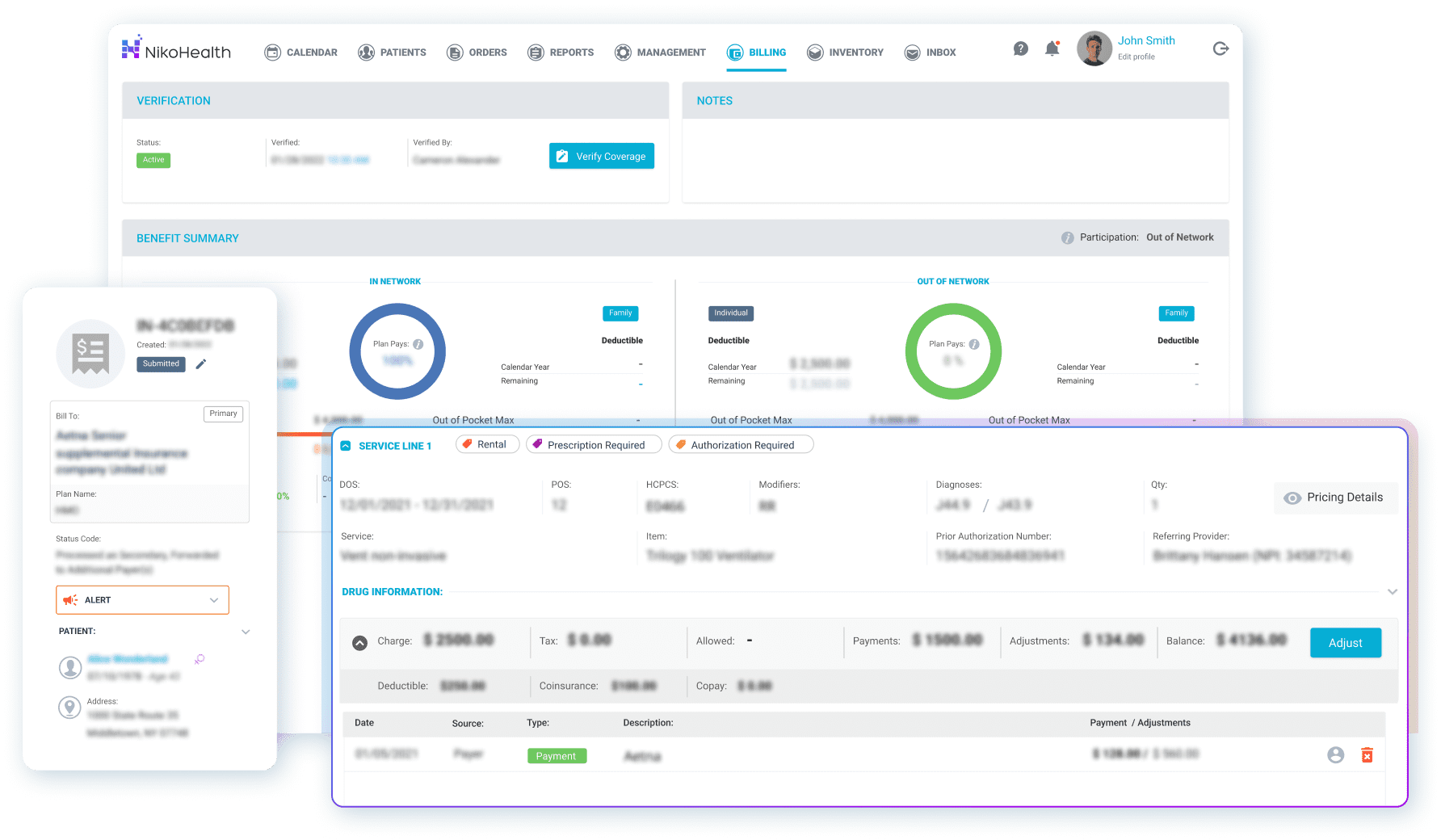
For large, multi-location DME providers, meeting Medicare requirements at scale means applying the same checks to every claim, at every branch, every day. NikoHealth’s HME/DME billing software is a cloud-based platform built for high-volume operations with complex billing. It runs billing on the same data as intake, orders, delivery, and inventory, so claims start with complete information.
Key Features
- Automated claims scrubbing. Catches errors before submission with pre-submission compliance checks.
- Payer rules engine. Configurable for Medicare and commercial payer requirements, documentation workflows, and frequency limits.
- Eligibility verification. Confirms coverage with Medicare and commercial payers before fulfillment and claim submission.
- Automated ERA/EOB posting. Posts Electronic Remittance Advice and Explanation of Benefits payments without manual reconciliation.
- Denial management. Identifies, queues, and routes denials for resolution.
- Audit-ready records. Stores orders, clinical documents, and proof of delivery from the field in one place.
- Security. HIPAA-compliant and ISO 27001-certified, with SSO and two-factor authentication.
Precision Medical Products consolidated several disconnected systems onto NikoHealth and reduced DSO from 120 to 75 days.


Related Articles