Most current DME/HME platforms, including NikoHealth, Brightree, and Bonafide, describe themselves as cloud-based DME software you open in a browser. Some older systems still install on a local server. The difference matters most for multi-location, high-volume suppliers, because it decides who runs backups, updates, and secure access for every branch.
Cloud-Based DME Software vs. Server-Based: The Difference
A server-based system runs on hardware your company owns or rents. Your team installs updates, runs backups, and connects branches, often through a VPN or remote desktop.
Cloud-based software runs on the vendor’s infrastructure. A cloud-native platform was built for the cloud from day one, not moved there from a desktop codebase. “Cloud” on a vendor website does not always tell you which one you are buying.
and both describe their platforms as cloud-based on their own websites. For any other vendor, ask where it runs, who patches it, and who restores it after an outage.
Side-by-Side Comparison
Factor | Server-based | Cloud-native |
Where it runs | Servers you own or manage | Vendor’s cloud infrastructure |
Updates | Installed by your IT team | Pushed by the vendor |
Backups and recovery | Your team runs them | Vendor runs the infrastructure side |
Branch and field access | Often VPN or remote desktop | Browser and mobile app from any site |
Does It Matter for a Company Your Size?
Single location, small team
Billing fit matters more. A server still leaves hardware, patches, and backups with you. HIPAA requires every covered entity to keep a data backup plan, a disaster recovery plan, and an emergency mode operation plan (), whatever the setup.
Multi-location, high-volume operations
It matters a lot. Every branch needs the same payer rules, live inventory, and real-time claim status, which is the core of on one system of record.
How NikoHealth Handles It
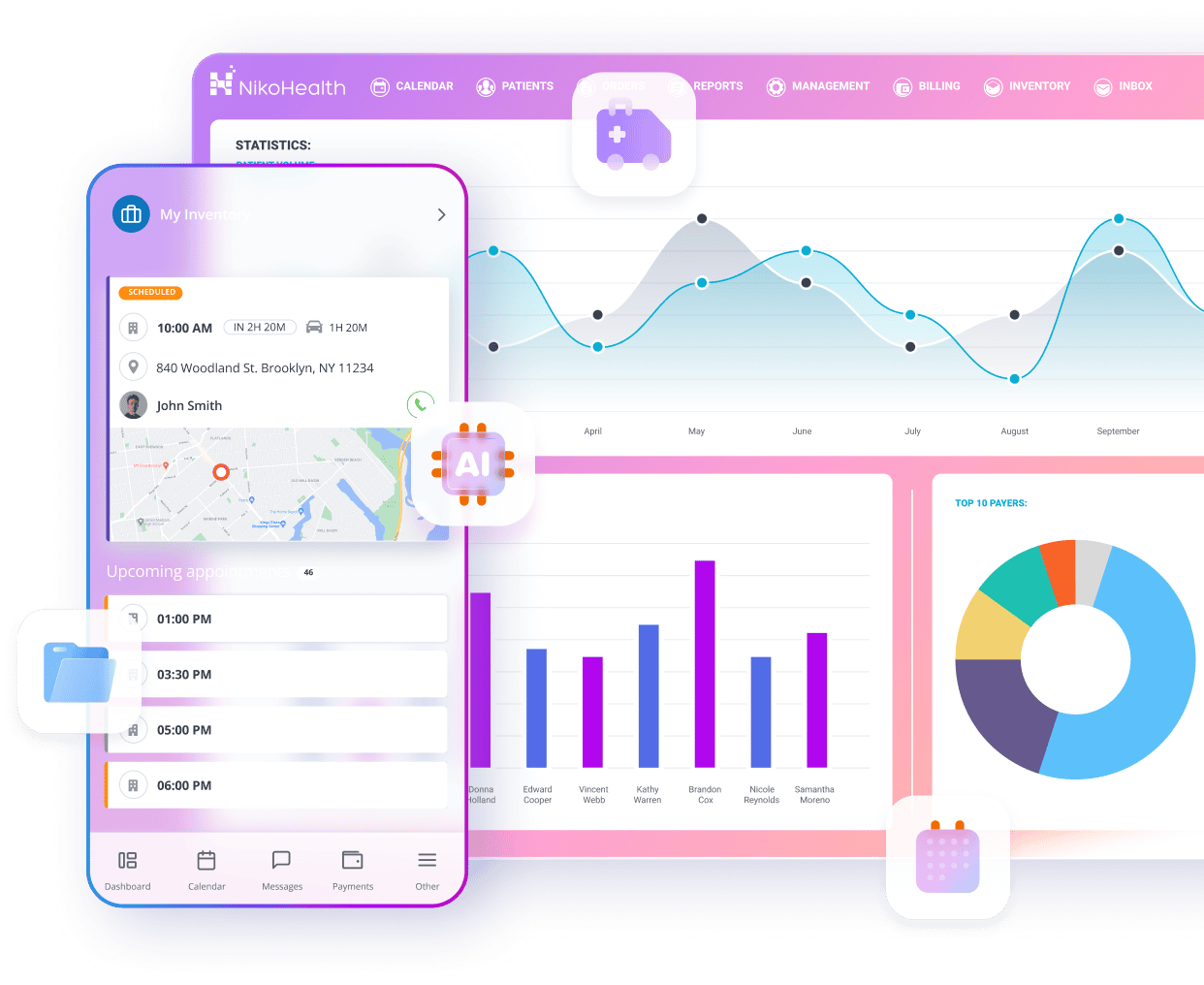
NikoHealth is cloud-native, with no on-premise option. It is built for large multi-location DME providers with complex billing across branches.
- Hosted on AWS across multiple availability zones, in an isolated private network
- AES-256 encryption in transit and at rest, plus SOC 2 Type II, ISO 27001, and HIPAA compliance ()
- A business associate agreement (BAA) on request, as requires of cloud providers
- SSO, 2FA, role-based permissions, and a reportable audit log
- A native iOS and Android app for delivery teams
Precision Medical Products consolidated its billing and order tools onto NikoHealth and cut days sales outstanding (DSO) from 120 to 75 days ().
The trade-off: no local install, and implementation for medium-to-enterprise providers typically takes 90 to 120 days.
Running several branches? See , compare the , or .