


US DME Market Size in 2026
Market research firms put the US durable medical equipment market in a narrow range for 2026. Their scope definitions differ, so treat these as directional estimates rather than audited figures.
Source | 2026 US estimate | Forecast | Growth rate |
|---|---|---|---|
$74.69 billion | $108.73 billion by 2033 | 5.51% CAGR | |
$74.62 billion | $121.34 billion by 2035 | 5.55% CAGR | |
$74.40 billion | $108.95 billion by 2033 | 5.6% CAGR |
Global estimates for 2026 range from $245.19 billion (Mordor Intelligence) to $280.6 billion (Global Market Insights), with North America holding the largest regional share.
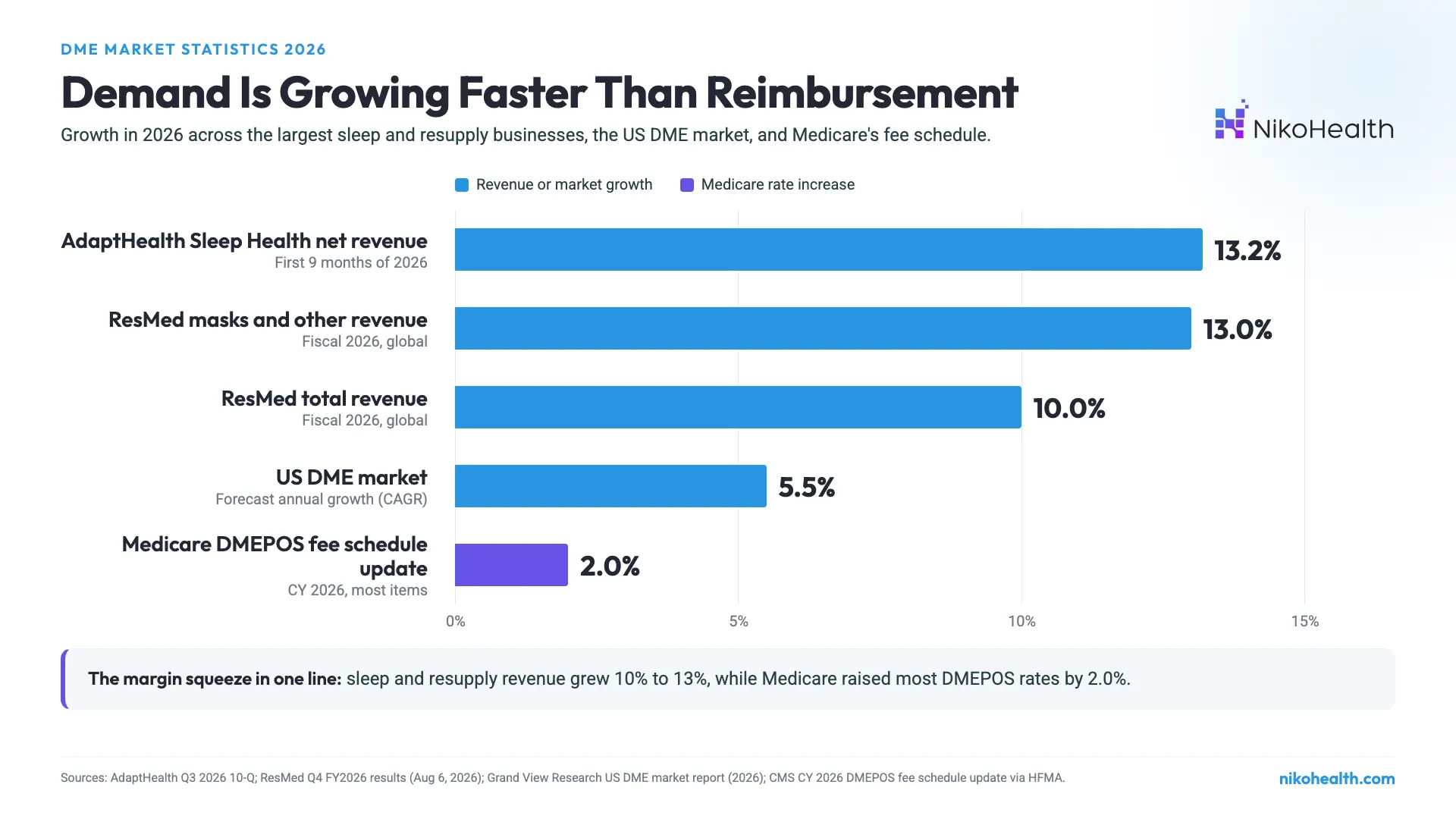
The takeaway for suppliers is steady growth, not a boom. A 5.5% growth rate means volume rises every year. But reimbursement is growing more slowly than costs, so the extra volume only turns into profit when operations scale without adding staff at the same rate.
Demand Drivers: An Older, Larger Medicare Population
DME demand follows age and chronic disease, and both are rising.
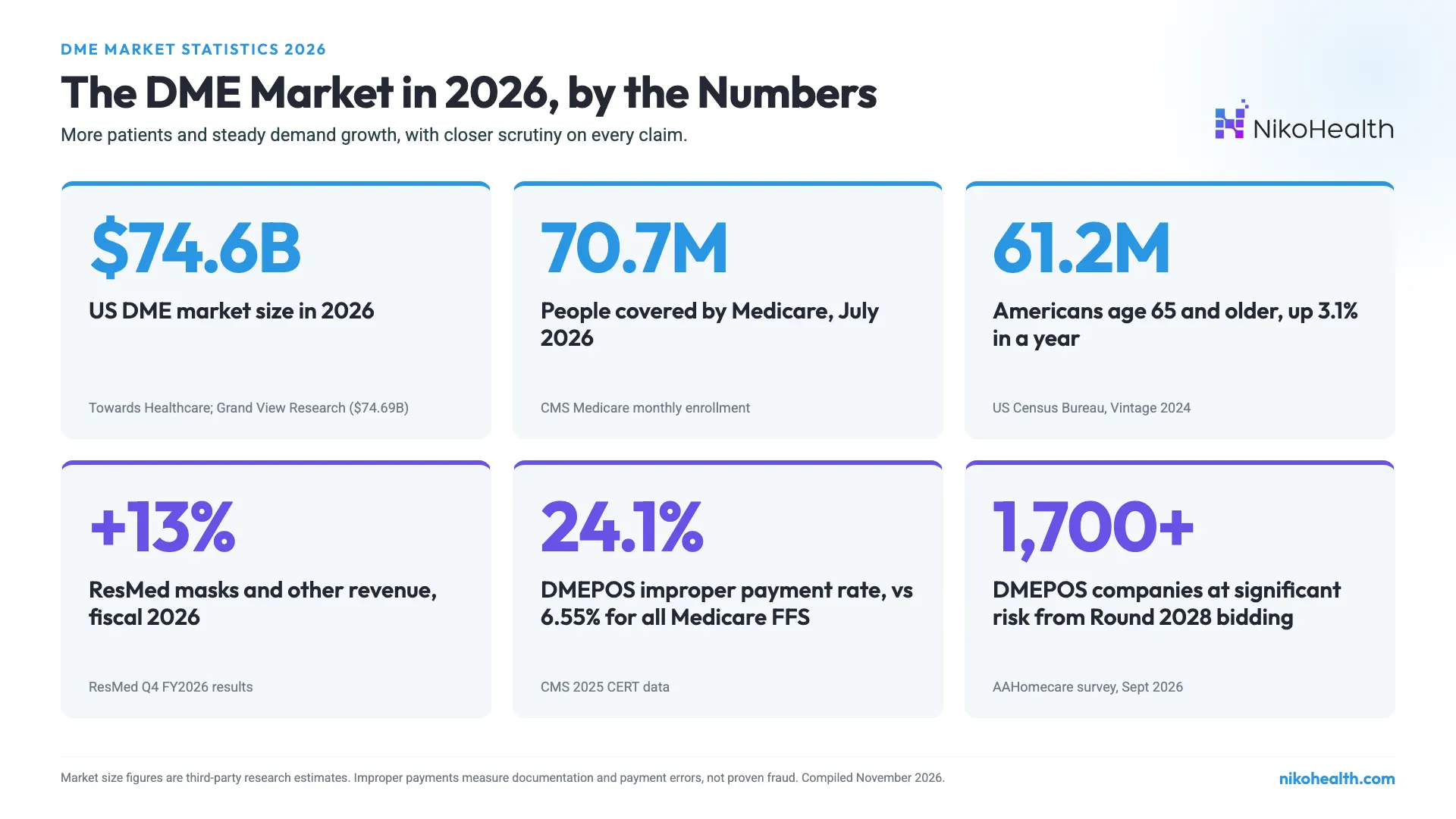
The US population age 65 and older grew 3.1% in one year to 61.2 million, according to the Census Bureau’s Vintage 2024 estimates. Older adults now make up 18.0% of the population, up from 12.4% in 2004, and they outnumber children in 11 states and in 45% of US counties. The Census Bureau projects the 65-plus share will reach 23.4% by 2060.
Medicare enrollment passed 70 million in early 2026 and reached about 70.7 million in July 2026, based on CMS Medicare monthly enrollment data. About 36.2 million of those people were in Medicare Advantage or other private plans, and about 34.6 million were in Original Medicare.
Medicare Advantage matters for DME because each plan sets its own authorization rules, networks, and documentation requirements. KFF reports that 55% of eligible Medicare beneficiaries are enrolled in Medicare Advantage in 2026. Enrollment grew by about 1.1 million people (3%) from 2025, with Special Needs Plans driving most of that growth.
The Resupply Market Is Growing Fastest
If one part of DME stands out in 2026, it is recurring supplies. CPAP masks, cushions, tubing, and filters are replaced on a schedule, which turns every new sleep patient into years of repeat orders. The public companies that report on this segment show it growing faster than equipment overall.
Indicator | 2026 figure | Source |
|---|---|---|
ResMed global masks and other revenue, fiscal 2026 | $2.085 billion, up 13% (12% in constant currency) | |
ResMed Americas masks and other revenue, fiscal 2026 | $1.513 billion, up 13% | ResMed Q4 FY2026 results |
ResMed total revenue, fiscal 2026 | $5.653 billion, up 10% | ResMed Q4 FY2026 results |
AdaptHealth Sleep Health net revenue, Q2 2026 | $386.5 million, up 15.5% | |
AdaptHealth Sleep Health net revenue, first nine months of 2026 | Up 13.2% ($132.9 million) | |
Global CPAP mask market, 2026 | About $3.15 billion, 6.63% CAGR to 2034 |
Two details stand out. First, ResMed’s mask revenue grew faster than its total revenue (13% against 10%), which means the consumables side of sleep therapy is pulling ahead of devices. Second, AdaptHealth credited higher PAP resupply patient census as one of the reasons for Sleep Health growth in its 2026 filings. Resupply is no longer a side business for sleep providers. It is a main growth line.
The Patient Pool Is Still Mostly Untreated
The American Academy of Sleep Medicine estimates that obstructive sleep apnea (OSA) affects nearly 30 million Americans and that about 80% of cases remain undiagnosed. Newer research suggests the true number may be higher. A 2026 study in Thorax estimated that about 23% of US adults have symptoms consistent with OSA, and nearly 30% of working-age adults (News-Medical summary). That study used self-reported symptoms, not sleep tests, so it is a proxy rather than a diagnosis count.
For suppliers, the gap between prevalence and diagnosis is the long-term growth runway. Every newly diagnosed patient who starts PAP therapy adds a resupply schedule that can run for years.
GLP-1 Drugs Have Not Shrunk Resupply Demand
When GLP-1 weight loss drugs took off, many expected fewer CPAP patients. ResMed’s claims analyses point the other way. The company reports that patients with both a GLP-1 and a PAP prescription were about 10% to 11% more likely to start PAP therapy, and had 5.1% higher two-year and 6.2% higher three-year resupply rates than PAP-only patients (MD+DI). These are company-reported, correlational findings, not clinical trials. Still, there is no sign so far that GLP-1 drugs are cutting into resupply volume.
CGM and Diabetes Supplies: Fast Growth, Big Rule Changes
Continuous glucose monitors (CGMs) are the other high-growth supply category. Mordor Intelligence estimates the US CGM market at $7.43 billion in 2026, up from about $6.28 billion in 2025, with an 18.23% annual growth rate through 2031.
Medicare coverage under the DME MAC CGM policy (LCD L33822) still requires insulin use or documented problematic hypoglycemia. Some consumer sites claim Medicare opened CGM coverage to all non-insulin type 2 patients in 2026. We could not confirm that change in the LCD, so suppliers should check the current policy on their DME MAC’s site before building volume forecasts on it.
The bigger change is payment. Under the CY 2026 final rule, CGMs and insulin pumps move into national remote item delivery competitive bidding in Round 2028, and contract suppliers will be paid through monthly rentals instead of purchase or capped rental. CMS projects about 10 national contract suppliers for the CGM and insulin pump category, according to its Round 2028 FAQs. Our CGM billing guide covers the monthly rental model in detail.
Reimbursement in 2026: Volume Up, Rates Barely Moving
Medicare’s CY 2026 DMEPOS fee schedule update, released December 19, 2025, applied these increases (HFMA):
Item group | CY 2026 update |
|---|---|
Most DMEPOS items | 2.0% |
Items furnished in former competitive bidding areas and mail-order diabetic testing supplies | 2.8% |
Lymphedema compression treatment items | 2.7% |
The 2.0% figure reflects a 2.7% CPI-U increase minus a 0.7% productivity adjustment. For most suppliers, that is less than the rise in wages, freight, and product costs. AdaptHealth’s filings show the effect: Sleep Health revenue grew 13.2% in the first nine months of 2026, but segment Adjusted EBITDA fell 5.9%, partly because of higher prices from a key supplier.
Commercial payers are also changing how they manage DME. In an HME News poll from May 2026, about 92% of respondents said at least one payer partner is already using or moving to a third-party administrator (TPA) model to manage DME benefits. TPAs add another layer of authorization rules, fee schedules, and documentation checks between the supplier and the payment.
The CY 2027 rates are not final yet. CMS published the CY 2027 Home Health and DMEPOS proposed rule (CMS-1844-P) on July 6, 2026, and the annual fee schedule update is usually released in December. You can track current rates on our Medicare DME fee schedule page.
Audits, Fraud Enforcement, and Compliance Pressure
2026 has been one of the most active years for DME oversight in a decade. The numbers explain why.
Statistic | Figure | Source |
|---|---|---|
DMEPOS improper payment rate, 2025 CERT | 24.1% (about $2.3 billion) | |
Overall Medicare fee-for-service improper payment rate, 2025 | 6.55% ($28.83 billion) | CMS 2025 CERT data |
Suspected fraudulent billing by 11 suppliers barred from Medicare Advantage | More than $3.4 billion | |
Suppliers that billed Medicare Advantage for DMEPOS but were not enrolled in Medicare | 1,342 of 21,029 | |
Nationwide enrollment moratorium for certain medical supply companies | February 27 to August 27, 2026 |
A 24.1% improper payment rate does not mean a quarter of DME claims are fraudulent. CERT measures payment errors, and most of them come from missing or insufficient documentation. That is why documentation gaps are the most common reason legitimate suppliers lose money in audits.
Several rule changes took effect in 2026 as a result. DMEPOS suppliers now go through accreditation every year instead of every three years. CMS added new HCPCS codes to the Required Prior Authorization List on April 13 and October 28, 2026, and probationary prior authorization for newly enrolled suppliers began October 15, 2026. Our DME compliance updates page tracks every change and deadline.
Competitive Bidding Round 2028: What the Numbers Say
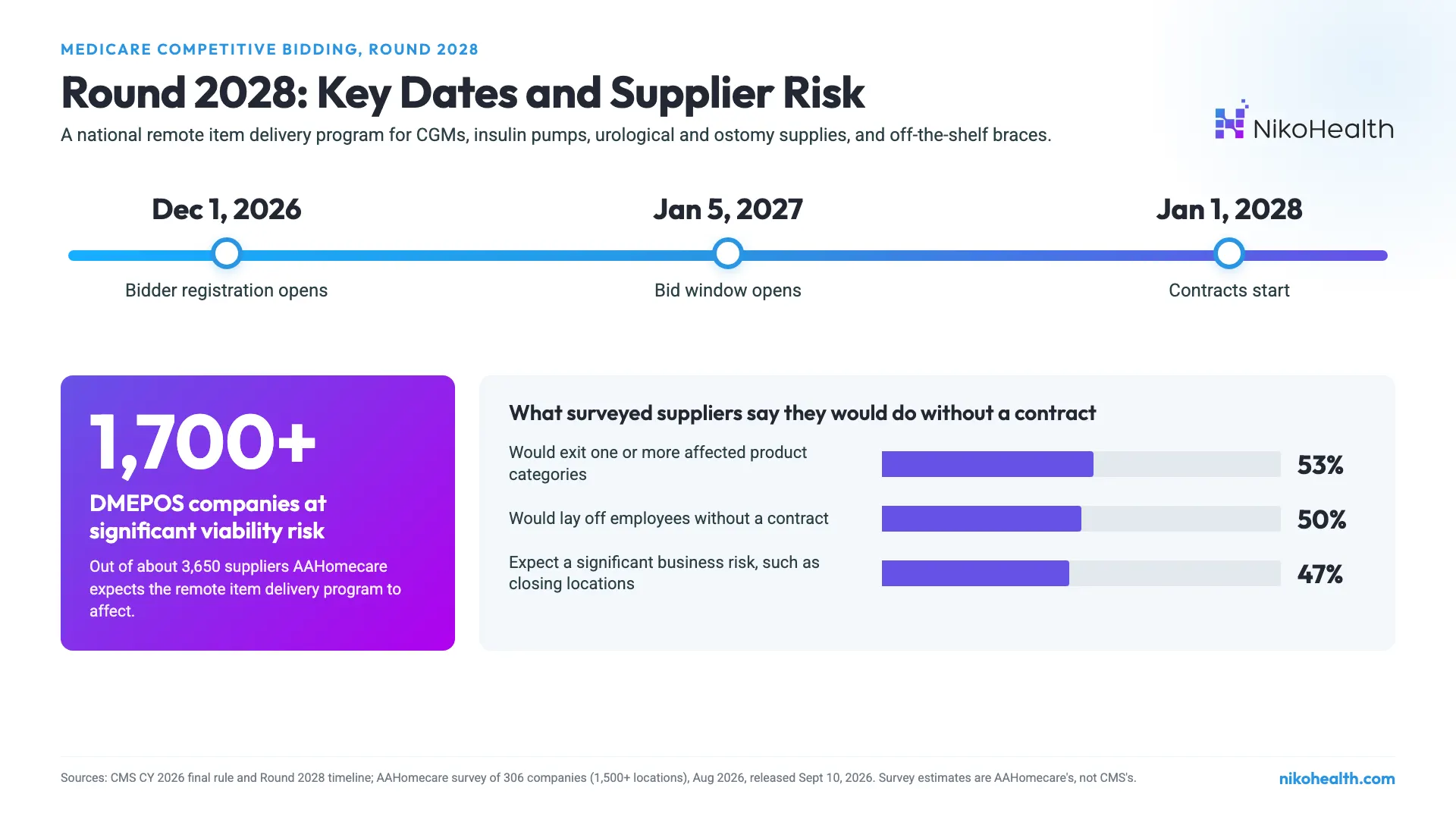
Competitive bidding returns on January 1, 2028, as a national remote item delivery program for CGMs, insulin pumps, urological and ostomy supplies, and off-the-shelf braces. Bidder registration opens December 1, 2026, and the bid window opens January 5, 2027.
AAHomecare surveyed 306 companies with more than 1,500 locations in August 2026 to estimate the impact (AAHomecare, September 10, 2026):
- About 3,650 suppliers would be affected by the remote item delivery program, based on Medicare claims data.
- More than 1,700 DMEPOS companies would face significant viability risk, extrapolated from the survey.
- 50% of respondents would lay off employees without a contract.
- 53% would exit one or more affected product categories.
- 47% expect a significant business risk, such as closing locations or going out of business.
These are an industry association’s estimates from a self-selected sample, and CMS has not adopted them. But they show how much of the supplies market could consolidate into fewer, larger operators after 2028. See our full guide to DMEPOS competitive bidding Round 2028 for dates and product categories.
What These 2026 Statistics Mean for DME Businesses
Put together, the 2026 numbers point to a few practical priorities.
Resupply is the growth engine, so treat it as a core operation. Patient pools for sleep and diabetes are growing, and recurring orders now drive revenue growth at the largest suppliers. Outreach timing, eligibility checks, and documentation for each resupply cycle decide how much of that demand actually turns into paid claims.
Margins depend on cost per order, not just volume. With a 2.0% Medicare update and rising product costs, revenue growth alone does not protect profit. The suppliers that stay healthy are the ones that handle more orders without adding staff at the same rate.
Documentation is a financial risk. With a 24.1% DMEPOS improper payment rate, annual accreditation, and expanding prior authorization, missing paperwork turns directly into denials, recoupments, and audit exposure. Clean documentation at intake and before claim submission is cheaper than fixing denials afterward.
Payer complexity keeps rising. Medicare Advantage now covers more than half of eligible beneficiaries, and commercial payers are moving DME benefits to TPAs. Each one brings its own rules, so tracking payer-specific requirements by hand gets harder every year, especially for multi-location operations.
Plan for consolidation. Round 2028 bidding, enrollment scrutiny, and margin pressure are likely to push smaller suppliers to sell, merge, or narrow their product lines. Larger operators that can absorb new branches and patient volume are best placed to grow.
How NikoHealth Supports High-Volume DME Operations
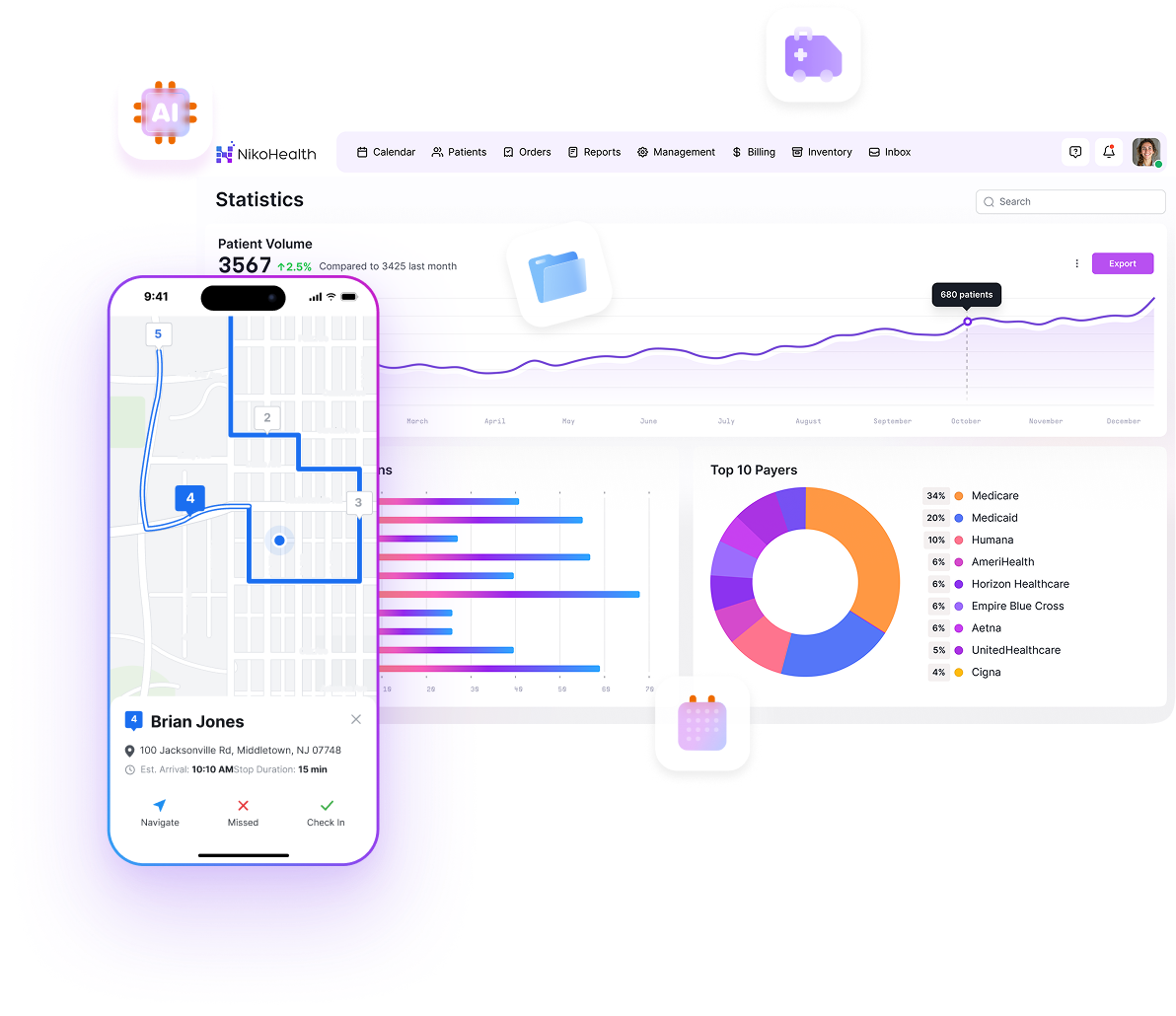
NikoHealth is a cloud-native platform built for large, multi-location HME/DME providers with complex billing across multiple branches. Its automated resupply sends texts, emails, and AI voice calls, and patients confirm orders through a secure magic link. Billing runs in the same system, with eligibility checks, pre-submission claims scrubbing, ERA/EOB posting, and denial management. Prime Care HME moved resupply, billing, and AR onto NikoHealth and cut daily payment posting from 3 hours to about 5 minutes (Prime Care HME case study).
To see how it would fit your operation, request a demo.
DME Market Statistics 2026 FAQ
How big is the US DME market in 2026?
Market research firms estimate the US durable medical equipment market at about $74.4 billion to $74.7 billion in 2026. Grand View Research puts it at $74.69 billion and forecasts $108.73 billion by 2033, a 5.51% annual growth rate.
Is the CPAP resupply market growing?
Yes. ResMed’s global masks and other revenue grew 13% to $2.085 billion in fiscal 2026, faster than its total revenue. AdaptHealth’s Sleep Health revenue grew 13.2% in the first nine months of 2026, and the company credited a higher PAP resupply patient census as one of the drivers.
How much did Medicare DME reimbursement increase in 2026?
The CY 2026 DMEPOS fee schedule update was 2.0% for most items, 2.8% for items in former competitive bidding areas and mail-order diabetic testing supplies, and 2.7% for lymphedema compression items.
What is the DMEPOS improper payment rate?
CMS’s 2025 CERT data put the DMEPOS improper payment rate at 24.1%, about $2.3 billion, compared with 6.55% for Medicare fee-for-service overall. Most improper payments come from missing or insufficient documentation, not proven fraud.
How many DME suppliers could be affected by Round 2028 competitive bidding?
AAHomecare estimates about 3,650 suppliers would be affected by the Round 2028 remote item delivery program and that more than 1,700 DMEPOS companies would face significant viability risk. CMS has not adopted these estimates.
Do GLP-1 drugs reduce CPAP demand?
Not so far. ResMed’s claims analyses show patients with both a GLP-1 and a PAP prescription were about 10% to 11% more likely to start PAP therapy and had higher two-year and three-year resupply rates than PAP-only patients. These are company-reported, correlational findings.

With over a decade of experience in medical software and hardware support, Alan combines technical expertise with hands-on client collaboration to help organizations achieve successful implementations.

Related Articles